
BTR 6C Anode Materials: The Key to Ultra-Fast Charging Explained
BTR Unveils Next-Gen 6C Ultra-Fast Charging Anodes in Hong Kong
BTR recently launched its latest generation of fast-charging anode materials in Hong Kong, showcasing two breakthrough 6C ultra-fast charging graphite products: T-Max (Artificial Graphite) and T-Pro (Natural Graphite). Both materials are engineered to meet the rigorous demand for a full charge within just 10 minutes.
Interestingly, at the beginning of this month, BYD officially released its Second-Generation Blade Battery, claiming a fast-charging capability of reaching approximately 97% SoC in about 10 minutes. This raises an intriguing question: Is the new Blade Battery powered by BTR’s latest technology? While not officially confirmed, there is a high probability that the industry leader in anode materials, BTR, has joined forces with top-tier battery manufacturer BYD to create this “phenomenal” product.
Without further ado, let’s dive into the technical details of our two protagonists—the T-Max and T-Pro ultra-charging anodes.
T-Max: The Second-Generation 6C Ultra-Fast Charging Artificial Graphite Anode
The second-generation T-Max has achieved significant breakthroughs in high-temperature, fast-charging cycle stability compared to its predecessor. Under 45°C and 6C ultra-fast charging conditions, its capacity retention has improved by 12%. Furthermore, after 90 days of storage at 60°C, its capacity retention saw an 18% increase. This indicates a substantial extension of battery service life under identical fast-charging and extreme storage environments.
But how were such remarkable performance gains achieved?
Material Innovation: T-Core Coke and Precision Modification
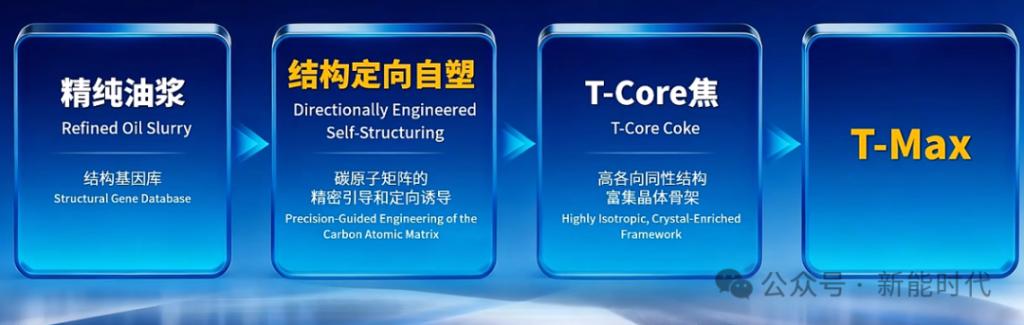
To achieve such extreme fast-charging performance, BTR first conducted rigorous screening and surface modification of the raw materials for their artificial graphite anodes. By screening the slurry (oil slurry) and implementing directional induction of carbon atoms, BTR succeeded in producing a highly isotropic coke. This specialized precursor is branded as T-Core Coke.
From Precursor to Product: Crystallographic Optimization
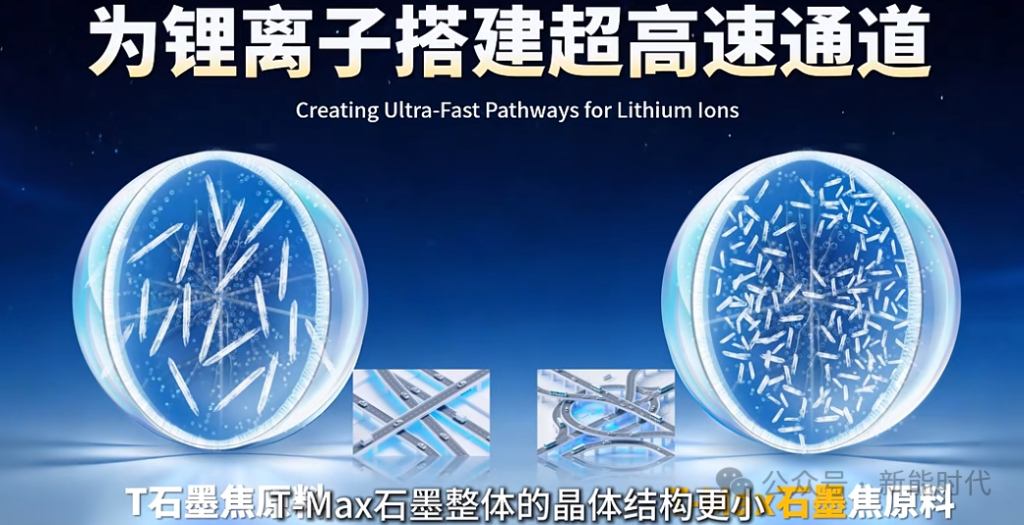
By sintering the T-Core coke, the ultra-fast charging artificial graphite, T-Max, is produced. As illustrated in the comparison figures below, the next-generation fast-charging graphite features a smaller crystalline grain size and a higher degree of disorder.
In professional terms, the OI value (Orientation Index) has been significantly reduced—by 25% compared to the previous generation. This reduction in the OI value corresponds directly to an increased number of diffusion pathways for lithium ions, facilitating the rapid intercalation required for ultra-fast charging performance.
Enhanced Stability through Surface Carbon Coating
The improvements in high-temperature cycling and storage performance are primarily attributed to the effectiveness of the carbon coating layer on the graphite surface. By suppressing surface side reactions (parasitic reactions), the loss of active lithium inventory is minimized, resulting in superior overall performance. Since surface coating technology has become relatively mature within the industry, it was not covered in extensive detail during the launch event.
T-Pro: The Industry’s First 6C Ultra-Fast Charging Natural Graphite Anode
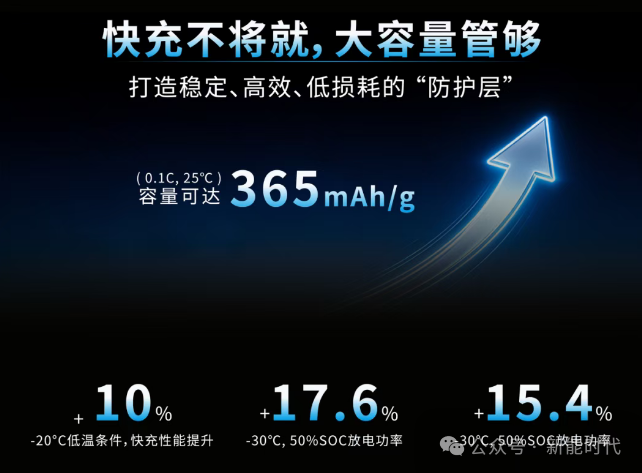
T-Pro stands as the industry’s first natural graphite anode material to achieve 6C ultra-fast charging capability. It delivers a high specific capacity of 365 mAh/g (tested at 0.1C and 25°C).
Beyond its charging speed, T-Pro exhibits exceptional low-temperature performance. Compared to the previous generation, its fast-charging capability at -20°C has improved by 10%. Furthermore, at -30°C and 50% SoC, its discharge and charge power have increased by 17.6% and 15.4%, respectively, ensuring reliable power delivery in extreme cold climates.
Structural Engineering: Optimized Diffusion Pathways
The exceptional specific capacity is primarily attributed to the near-perfect crystalline structure of natural graphite. However, its inherent drawbacks include difficulty in meeting fast-charging requirements and relatively poor cycling stability.
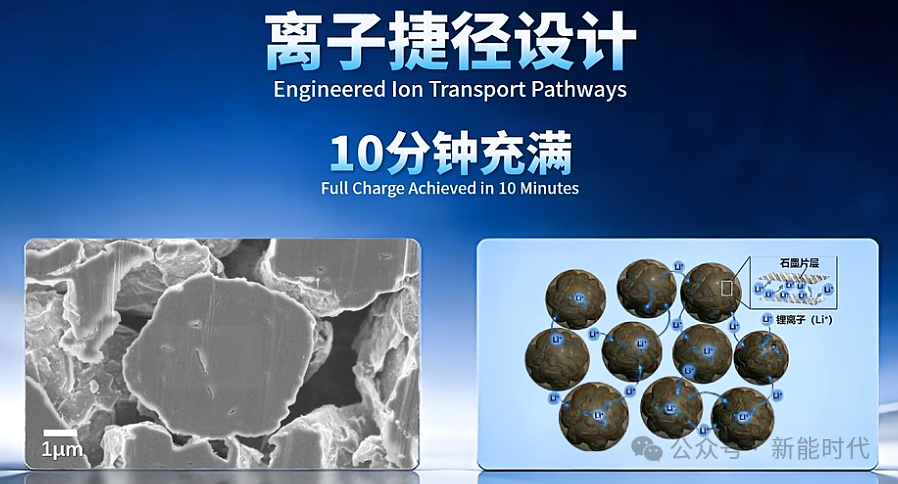
To address these limitations, BTR focused on optimizing lithium-ion transport pathways. By implementing a “Ion Shortcut” design, they established low-impedance, high-efficiency channels for ion transmission, significantly enhancing the kinetic performance of the material.
Interface Engineering: Stable SEI and Low Expansion
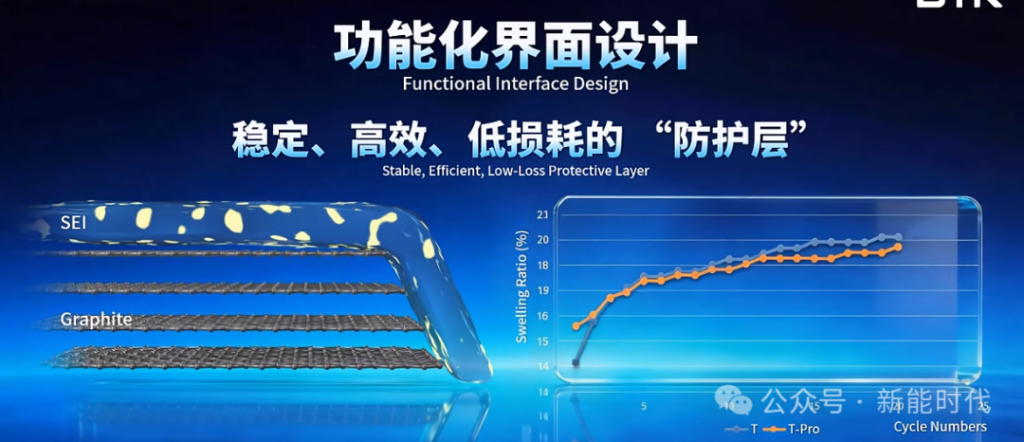
To address the poor cycling stability of natural graphite, BTR implemented a functionalized interface design to construct a highly stable SEI (Solid Electrolyte Interphase) layer. This minimizes active lithium loss during operation. Beyond conventional coating techniques, this approach likely involves artificial SEI (a-SEI) formation technology.
Furthermore, the design ensures that the expansion level of the natural graphite is nearly identical to that of artificial graphite. Achieving such controlled swelling in natural graphite is a unique, industry-leading breakthrough.
Market Outlook: BTR Solidifies Its Dominance in the Fast-Charging Era
Based on the major industry launches early this year, ultra-fast charging remains an unavoidable hotspot and a centerpiece of the battery sector. The technical bottleneck of fast charging is primarily concentrated at the anode side. Fundamentally, fast charging requires a massive influx of lithium ions to reach the anode in a very short duration; therefore, the anode must possess an exceptional capability for rapid ion reception. Failure to do so significantly increases the risk of lithium plating, which compromises safety and cycle life.
BTR’s simultaneous release of both artificial and natural 6C ultra-fast charging graphite anodes marks an industry first. This achievement establishes BTR as the only enterprise globally capable of mass-producing both types of 6C anode materials. While this launch can be viewed as a powerful “display of technical prowess,” it is deeply rooted in BTR’s long-standing technical accumulation in graphite research. These two products will further consolidate BTR’s position as the undisputed leader in the anode market, and will undoubtedly accelerate the research and development of fast-charging technologies across the entire industry.
Neware All-in-One Battery Test Solution for battery material research and coin cell testing
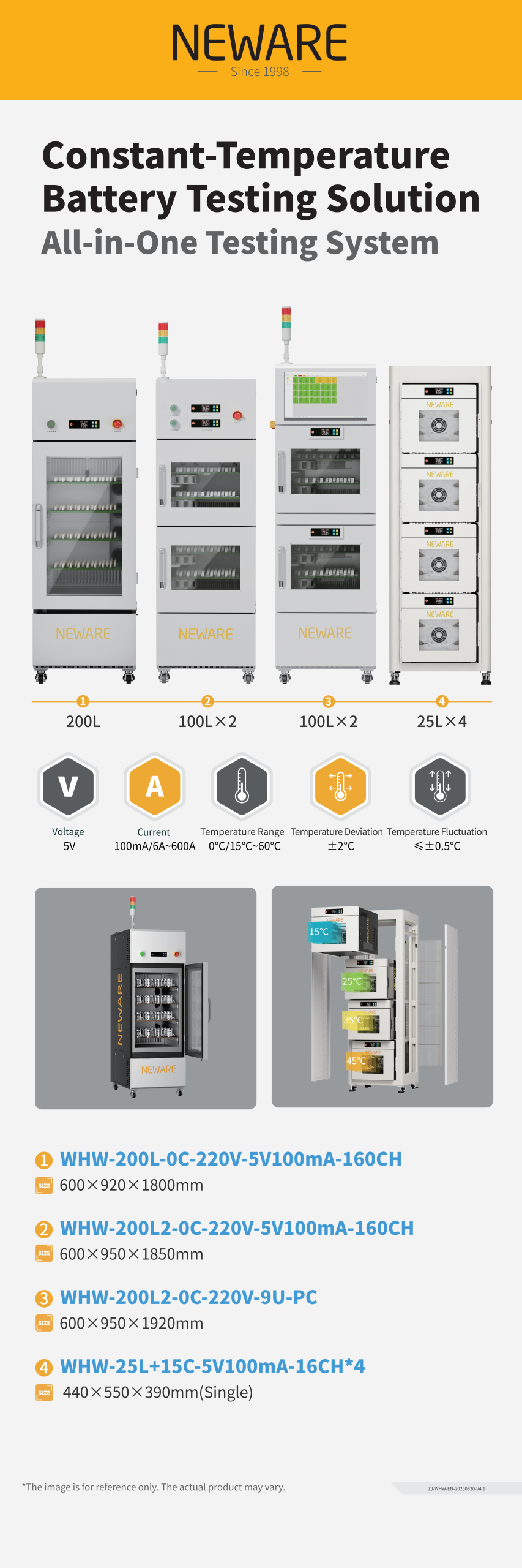
Neware was founded in 1998. We are trusted by ATL, BYD, CATL, Tesla, Apple, HUAWEI, BTR, SolarEdge, etc. We provide battery testing solutions for testing battery cell, module, pack, supercapacitor, BESS, etc. If you want to do capacity, cycle life, pulse, DCIR, GITT, HPPC, or EV driving simulation test, please feel free to contact us.
BTR 6C Anode Materials: The Key to Ultra-Fast Charging Explained