
The First All-Solid-State Battery Test Report Released by Donut Lab
The Following is the Response from Google Gemini
Publication Date: February 2026
Testing Entity: VTT Technical Research Centre of Finland
Cell Type: 26Ah Solid-State Pouch Cell
1. Test Objectives and Scope
The independent validation conducted by VTT focused on the Extreme Fast Charging (XFC) capabilities and thermal stability of Donut Lab’s solid-state battery (SSB) prototypes. The test aimed to verify the high-rate performance claims made by the Finnish startup during CES 2026.
2. Extreme Fast Charging (XFC) Performance
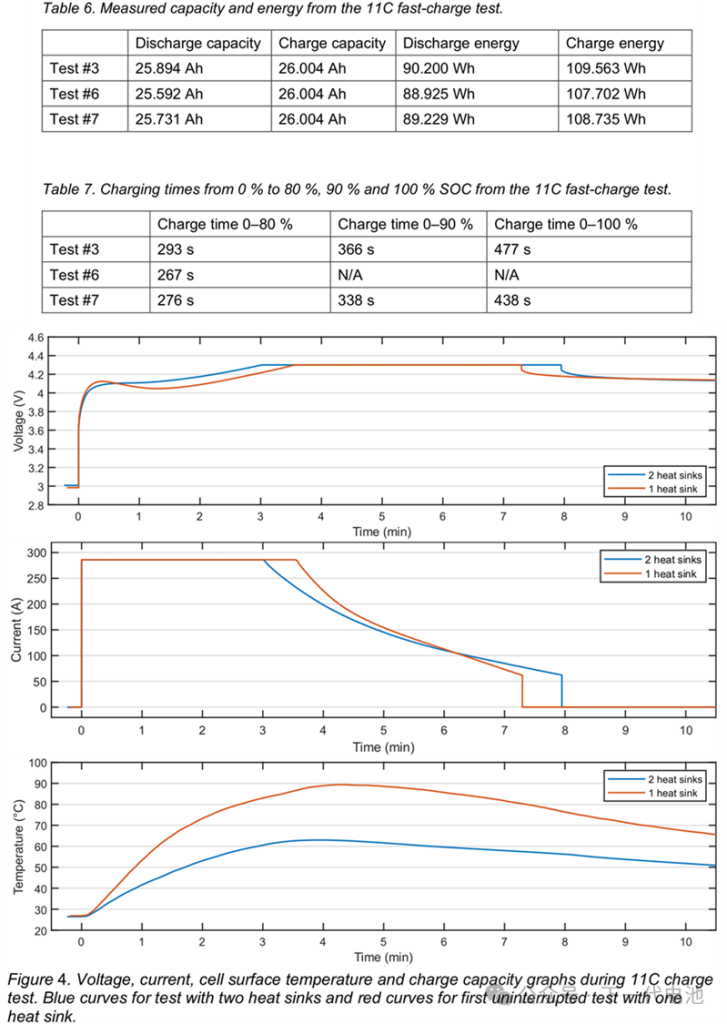
11C Charge Rate: The cell demonstrated an extreme charging capability, reaching an 80% State of Charge (SoC) in just 4.5 minutes. A full 0-100% charge was achieved in approximately 7 minutes.
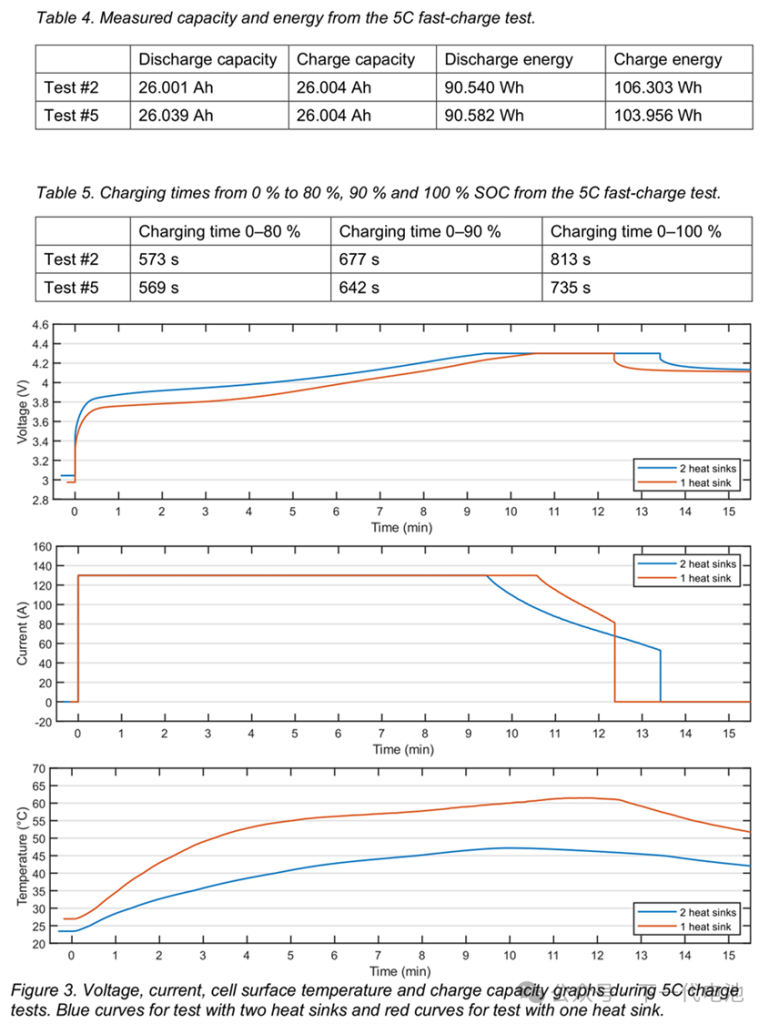
5C Charge Rate: The cell reached 80% SoC in 9.5 minutes and a full 100% SoC in roughly 12 minutes.
Capacity Retention: Following these high-rate cycles, the cell maintained 98.4% to 100% of its available discharge capacity, indicating minimal immediate degradation from high-power input.
3. Thermal Management and Stability
Passive Cooling: A key takeaway from the report is the battery’s ability to handle high C-rates with minimal or passive cooling.
Temperature Limits: During 11C charging with dual heatsinks, the surface temperature peaked at 63°C. In a “worst-case” scenario with a single heatsink, the temperature reached a safety limit of 90°C, triggering a brief protection pause, yet the cell showed no signs of ignition or thermal runaway.
Ambient Robustness: Although not the primary focus of this specific report, the chemistry is designed for extreme environments, claiming over 99% capacity retention at -30°C.
4. Mechanical and Structural Advantages
Low Operating Pressure: Unlike many solid-state competitors that require high external stack pressure (e.g., 50+ psi), the Donut Lab cell operates effectively without high compressive forces.
Volumetric Stability: The cells exhibit negligible volume change during cycling, simplifying battery pack architecture and thermal interface requirements.
5. Technical Commentary
The VTT report confirms that Donut Lab has achieved a significant breakthrough in ionic conductivity and interfacial stability, allowing for charging speeds that exceed current liquid-electrolyte lithium-ion standards. While claims of a 100,000-cycle life and 400 Wh/kg energy density still require long-term verification, this first report serves as a robust proof-of-concept for their high-power solid-state architecture.
The following insights are shared by a Chinese battery industry expert, originally published on the WeChat Official Account: Next-Generation Batteries (下一代电池).
The Finnish startup Donut Lab sent shockwaves through the battery industry at this year’s Consumer Electronics Show (CES) by claiming to have a mass-production-ready solid-state battery. Their assertions were nothing short of explosive: an energy density of 400 Wh/kg, a 5-minute charge time, a cycle life of 100,000 cycles, and an exceptional operating temperature range. However, since these claims were initially made without supporting empirical data, many industry heavyweights voiced significant skepticism.
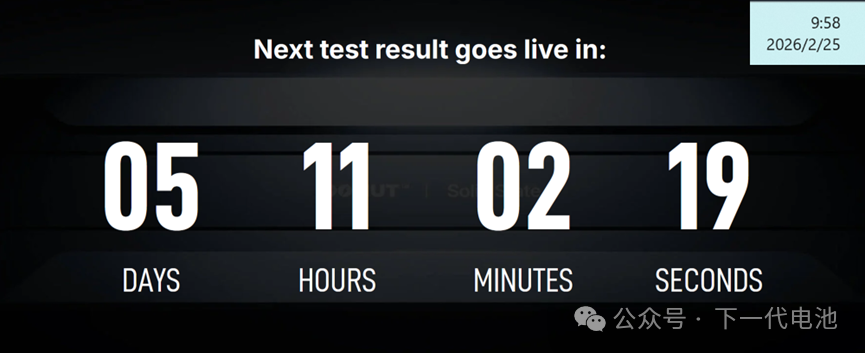
Recently, Donut Lab released its first third-party test report. Regardless of the specific results, the courage to publicly disclose actual testing data is highly commendable. According to Donut Lab, a second third-party report is expected to be released shortly—we will be watching closely. For now, let’s dive into the details of this first report.
1. Test Overview of Donut Lab Battery Cells
We previously shared third-party validation reports from other solid-state battery companies, such as the QuantumScape single-layer cell report. Comparing the two, the third-party report provided by Donut Lab is somewhat lacking in comprehensive detail regarding sample specifications.
This report was issued by VTT Technical Research Centre of Finland. VTT is a state-owned, non-profit research organization under the Finnish Ministry of Economic Affairs and Employment. It acts as a bridge between fundamental research (universities) and industrial production (corporations), focusing on applied research, technology transfer, and professional consulting (similar to the early concept of National Manufacturing Innovation Centers in China).
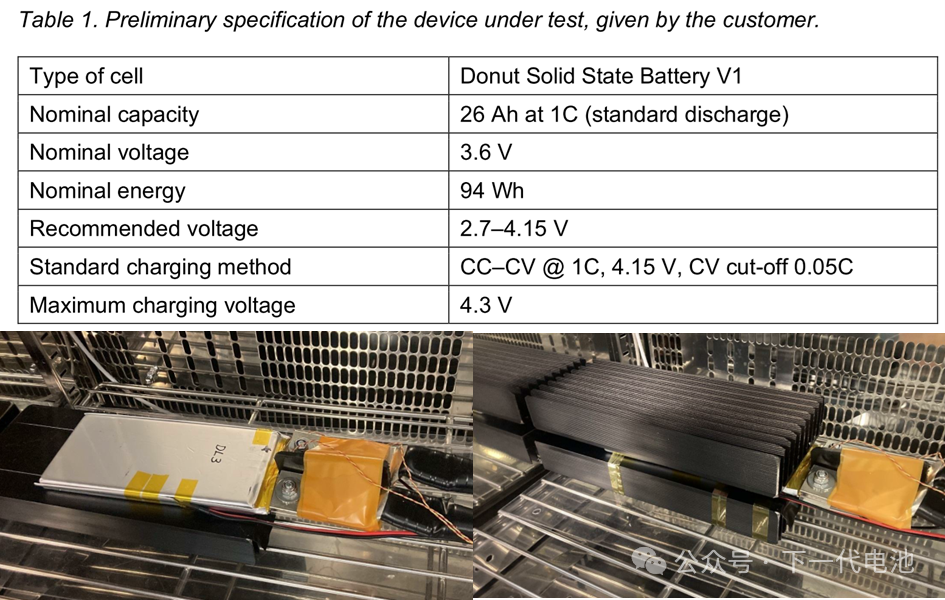
The cells have a nominal capacity of 26Ah and a nominal voltage of 3.6V, with an operating voltage window of 2.7–4.15V. Based on the nominal voltage, the chemistry appears to be a ternary (NCM/NCA) system. If we assume an energy density of 400 Wh/kg, the cell weight should be approximately 230g. Regarding the “5-minute charge” claim: if this refers to a full 0–100% SoC range, it would require a 12C rate (312A); if it refers to a 10–80% SoC range, it equates to roughly 8.4C (218A).
The cell features a rectangular form factor with single-side tabs (terminals). Based on the report photos, the cell aspect ratio is quite elongated. Combined with the single-side tab design, this could lead to thermal management challenges. During testing, the cells were likely placed in a forced-air convection oven. To manage heat, cooling plates were placed on both sides of the cell, though the specific parameters of these plates remain unclear. Furthermore, since the temperature sensors were positioned on the sides and tabs, the actual cooling efficiency is difficult to determine.
For extreme fast charging (XFC), the cell structural design could be optimized—for instance, by switching to a dual-side (opposing) tab design. The test setup could also be improved for better results, such as using liquid cooling or immersion cooling.
The testing was conducted under three conditions: 1C, 5C, and 11C. The upper cutoff voltage was set at 4.15V for 1C; however, to account for polarization, the charge cutoff voltage was increased to 4.3V for the 5C and 11C tests.
2. Test Results of Donut Lab Battery Cells
1) 1C Testing
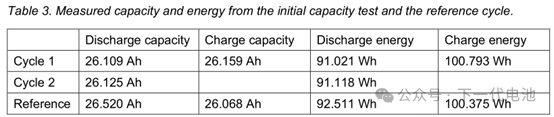
Three cells were tested at the 1C rate, with the sample labeled “Ref” utilizing a single-sided heatsink configuration. Regarding the CC (Constant Current) stage duration, the charging time exceeded one hour, indicating a high CC-ratio, which is generally considered a positive performance indicator.
The average discharge voltage was 3.49V, which is relatively mediocre; this resulted in the measured energy being lower than the nominal energy. Furthermore, it was observed that the cell with the single-sided heatsink exhibited slightly higher discharge capacity and energy, likely due to a higher operating temperature (which typically enhances ionic mobility but may impact long-term stability).
2) 5C Testing
The capacity retention at 5C was quite impressive, approaching 100% (though it should be noted that this may be partially attributed to the elevated operating temperatures). With dual-sided cooling plates, the maximum temperature rise was in the 20°C range, whereas the cell with the single-sided cooling plate saw a temperature spike of nearly 40°C. This indicates significant heat generation; if integrated into a full pack or system, these thermal management issues would become even more pronounced. At the 5C rate, the battery charged from 0% to 80% SoC in under 10 minutes, which is a solid performance.
3) 11C Testing
At higher C-rates, the most critical challenge remains thermal runaway management (temperature rise). When the charging rate was increased to 11C, the constant current could only be sustained for approximately 3 minutes. By the 4-minute mark, the temperature reached its peak. With dual-sided cooling plates, the maximum temperature rise was approximately 40°C; however, the cell with only single-sided cooling reached a maximum absolute temperature of 89°C.
In terms of discharge capacity and average discharge voltage, the performance remains quite robust—though it must be noted that these results do not account for the impact of the accelerated temperature rise on long-term degradation.
4) Questions
While I appreciate the practice of publicly releasing third-party test reports, the results weren’t particularly impressive, and many questions remain. First, how can it be described as a solid-state battery? (Should it be tested according to Chinese solid-state battery standards?) Second, regarding the 400Wh/kg battery material system, currently publicly available batteries have an average 1C discharge voltage of less than 3.48V. Judging from the curve, the battery should have a ternary cathode, but the anode is definitely not metallic lithium. So, how can an energy density of 400Wh/kg be achieved? Of course, there are many more questions, which I won’t list here, and I welcome discussion.
In conclusion, the practice of publicly disclosing test results deserves praise, and we hope to see more solid-state battery companies release their results. We also look forward to Donut Lab’s new report in five days.
Special Statement and Clarification: The information in this article comes from publicly available online sources. The author has strived to ensure the article’s accuracy, but due to time and limited information sources, the author has no obligation to verify its authenticity. Readers are advised to be aware of this or choose to ignore it. If you find any inappropriate points or areas for improvement in the article, please leave a message to contact the author. Furthermore, this is the author’s personal public account and is unrelated to their employer.
Due to the limited knowledge and English level is inevitable errors and omissions, if there are errors or infringement of the text, please contact me as soon as possible by private letter, I will immediately be corrected or deleted.