
Reference for Li-Cu Battery Testing: Assessing Coulombic Efficiency in Lithium Metal Anodes
Team of Professor Lorenzo Stievano, University of Montpellier, France – Chemistry of Materials
Abstract
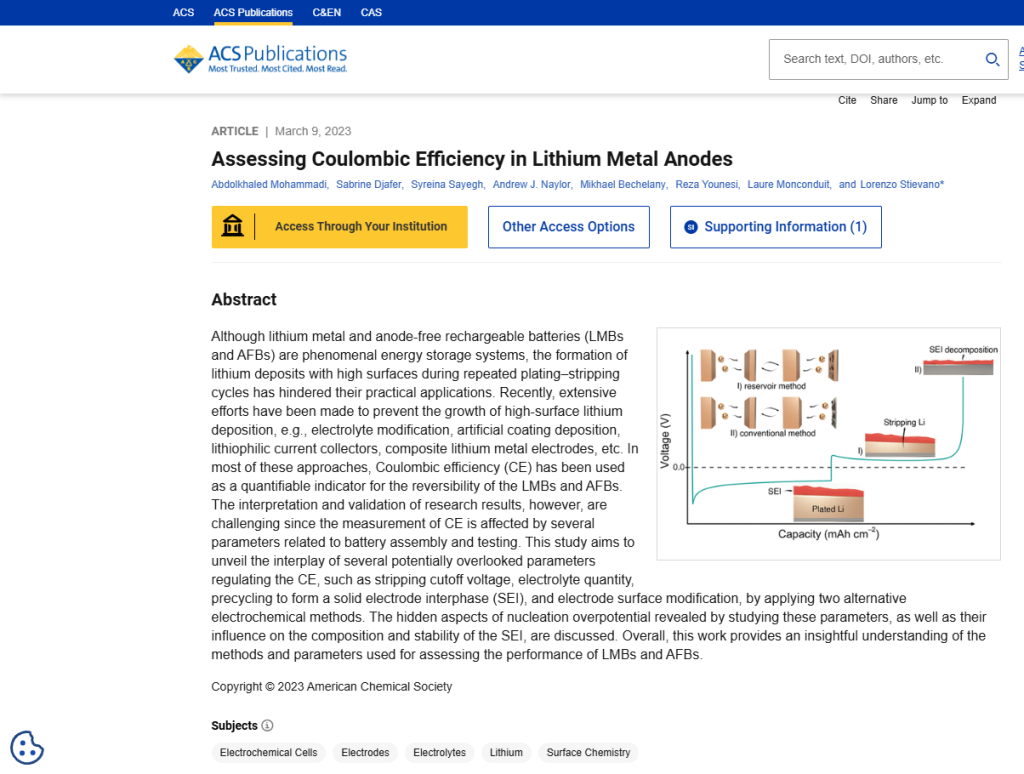
Although lithium metal and anode-free rechargeable batteries (LMBs and AFBs) are phenomenal energy storage systems, the formation of lithium deposits with high surfaces during repeated plating–stripping cycles has hindered their practical applications. Recently, extensive efforts have been made to prevent the growth of high-surface lithium deposition, e.g., electrolyte modification, artificial coating deposition, lithiophilic current collectors, composite lithium metal electrodes, etc. In most of these approaches, Coulombic efficiency (CE) has been used as a quantifiable indicator for the reversibility of the LMBs and AFBs. The interpretation and validation of research results, however, are challenging since the measurement of CE is affected by several parameters related to battery assembly and testing. This study aims to unveil the interplay of several potentially overlooked parameters regulating the CE, such as stripping cutoff voltage, electrolyte quantity, precycling to form a solid electrode interphase (SEI), and electrode surface modification, by applying two alternative electrochemical methods. The hidden aspects of nucleation overpotential revealed by studying these parameters, as well as their influence on the composition and stability of the SEI, are discussed. Overall, this work provides an insightful understanding of the methods and parameters used for assessing the performance of LMBs and AFBs.
Article Images
CONCLUSIONS
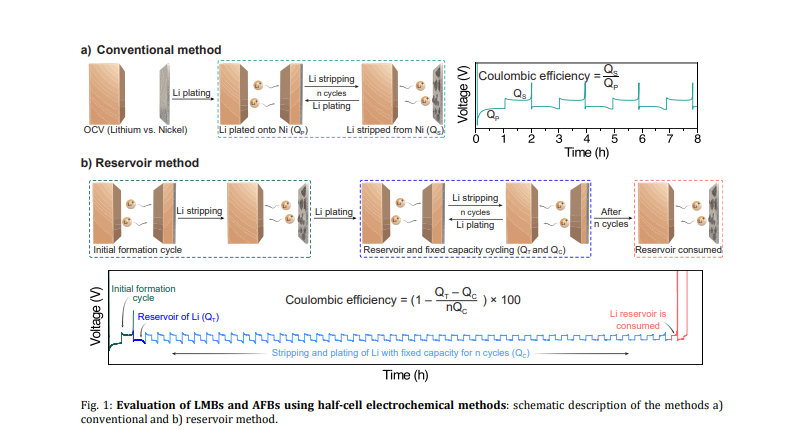
Two different electrochemical methods were utilized in this study to highlight the effect of different experimental factors, which are often neglected in many studies, on the measurement of CE and cycling performance of LMBs/AFBs. Hidden and inconspicuous electrochemical and cell parameters can substantially affect the performance of the benchmark system. As a result of the findings in this paper, several key points were clarified:
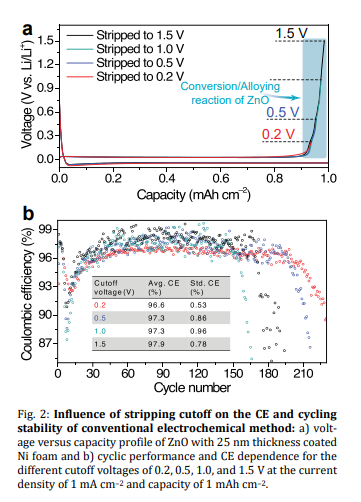
Cutoff: Despite the fact that the average CE decreases by lowering the upper cutoff potential in the conventional electrochemical method, the cycle life can be extended. In other words, increased high cutoff potentials lead to reduced lifespan due to the further decomposition of electrolytes and irreversible electrochemical reactions. Accordingly, the lower cutoff voltage is recommended for lithium plating and stripping tests.
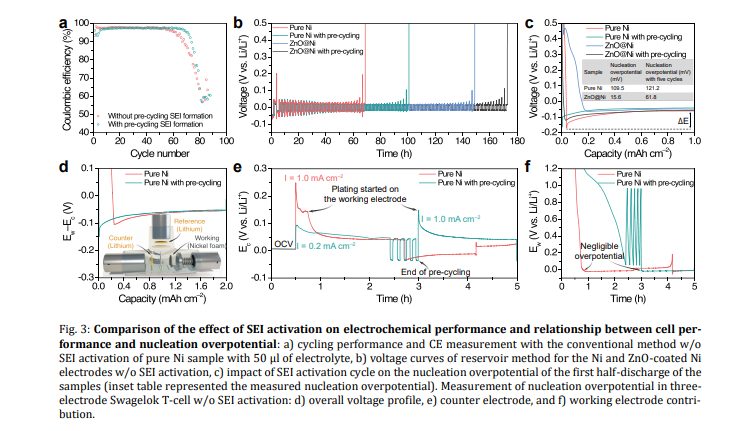
Pre-cycling for initial SEI formation: Galvanostatic precycling to form and stabilize SEI is here shown to not affect the cycling performance and CE measurements for the conventional electrochemical method. Most probably, the stabilized SEI can be easily changed and damaged by the complete stripping of lithium and the continued plating of Li. However, in the reservoir method, stabilizing the SEI via pre-cycling before lithium deposition improved CE values. Due to the initial SEI formation, the nucleation overpotential of the electrode increases; this allows the unveiling of the hidden aspects of the nucleation overpotential of the batteries. Use Neware battery cyclers for Pre-cycling
Nucleation overpotential: The results from three-electrode cells indicate that the energy barrier for stripping or extracting lithium from the lithium metal counter electrode is significantly higher than the energy barrier for forming nucleation sites on the working electrode when the cell starts cycling. This also explains why the pre-cycling to form initial SEI induced a higher nucleation overpotential.
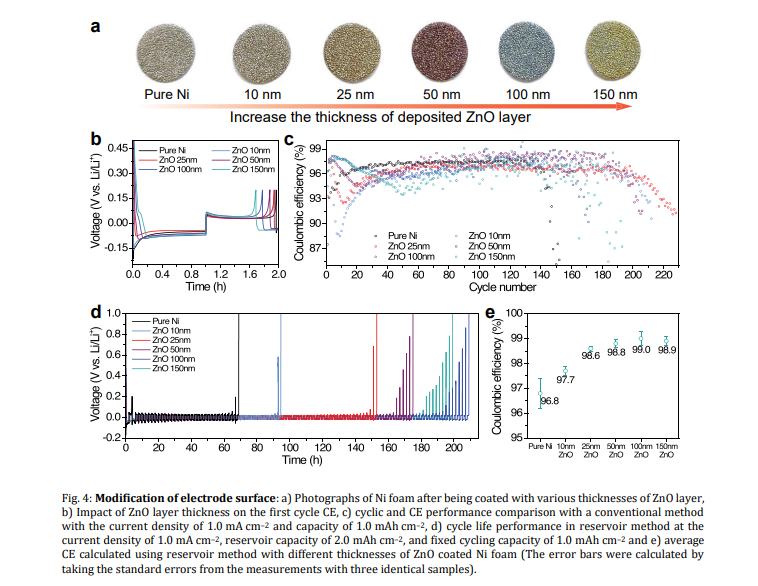
Modification of electrode surface: The optimal thickness of ZnO coating on the Ni foam current collector was shown to be below 50 nm when using the conventional method, whereas increasing the thickness improves the performance in the reservoir method. The results indicate that the lower thickness of ZnO would be more suitable for use in AFBs with a limited source of lithium in the cathode electrode, whereas a higher thickness of ZnO would be more beneficial for infusing molten lithium to use as an anode in the LMBs. In general, it is challenging to determine the effective optimal thickness of coatings in modified materials.
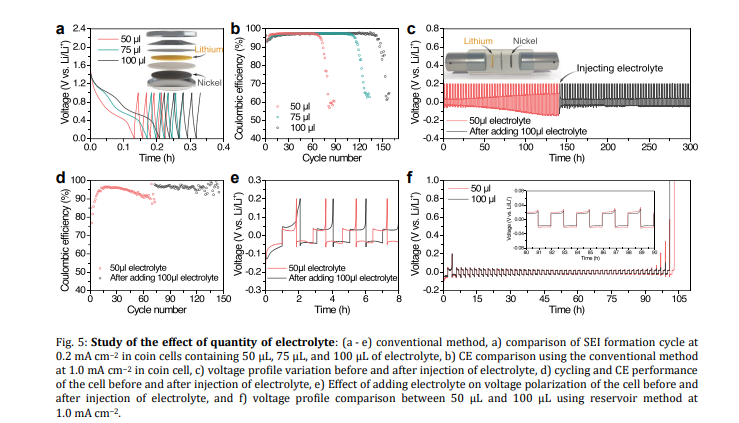
Quantity of electrolyte: In the conventional electrochemical method, the mechanism of cell failure is electrolyte depletion rather than dendrite formation, and the cycle life of a battery is directly proportional to its electrolyte volume. In contrast, the reservoir method shows that the failure is independent of the amount of electrolyte. Furthermore, XPS analysis reveals that the evolution of SEI during lithium plating and the entire stripping of lithium for each cycle leads to electrolyte depletion in the conventional electrochemical method.
SEI in AFBs: The results for AFBs show similar that the cycled life could be improved by keeping some metallic lithium on the anode electrode, resulting in higher stability of the SEI and thus higher CE values.
We believe that by gathering this type of information, researchers may be able to gain a deeper understanding of the efficiency of different parameters but also of different analytical methods in the thorough understanding of lithium plating and stripping processes.
Article title: Assessing Coulombic Efficiency in Lithium Metal Anodes https://doi.org/10.1021/acs.chemmater.2c03518
Source: WeChat Official Account “Brother Radish” 萝卜大师兄