
Most Characterization Methods and Techniques in Battery R&D
A systematic characterization framework for battery materials (e.g., lithium/sodium-ion, lithium-sulfur, and solid-state batteries), encompassing structural, electrochemical performance, and interfacial behavior analysis:
1. Structural Characterization
| Technique | Abbr. | Analysis Content | Judgment Criteria / Standard |
| Scanning Electron Microscopy | SEM | Surface morphology, particle size, pore structure. | Uniform particles; no cracks or agglomeration. |
| Transmission Electron Microscopy | TEM | Microstructure, lattice fringes, defects. | Clear lattice structure; no phase separation. |
| Atomic Force Microscopy | AFM | Surface roughness, mechanical properties. | Solid electrolyte surface roughness <10nm. |
| X-Ray Diffraction | XRD | Crystal structure, phase purity, lattice parameters. | No impurity phases; lattice strain <2%. |
| Neutron Diffraction | ND | Site occupancy analysis of light elements (Li/H). | Clear Li+ migration pathways. |
| Specific Surface Area Analysis | BET | Specific surface area, pore size distribution. | Anode <10m2/g; Cathode >50 m2/g. |
| Mercury Intrusion Porosimetry | – | Macropore distribution (for thick electrodes). | Porosity >30% and well-interconnected. |
| Rutherford Backscattering | RBS | Thin film composition and thickness. | Composition gradient matches design. |
| Auger Electron Spectroscopy | AES | Surface element distribution (e.g., Li+, depth profiling. | Uniform Li distribution; no local enrichment. |
2. Compositional and Chemical State Analysis
This section focuses on identifying the elemental constituents of the materials and their electronic environments, which are critical for understanding redox mechanisms and surface stability.
| Technique | Abbr. | Analysis Content | Judgment Criteria / Standard |
| X-ray Photoelectron Spectroscopy | XPS | Surface elemental valence states; SEI components (e.g., LiF, Li2O). | High valence state metals present (e.g., Ni3+); high proportion of inorganic SEI layers. |
| Energy Dispersive Spectroscopy | EDS | Elemental distribution (e.g., uniformity of S/C composites). | Uniform elemental distribution. |
| Time-of-Flight Secondary Ion Mass Spectrometry | TOF-SIMS | Depth profiling of SEI/CEI film components. | Organic outer layer (ROCO2Li); inorganic inner layer (LiF). |
| Fourier Transform Infrared Spectroscopy | FTIR | Functional group changes (e.g., electrolyte decomposition products). | Absence of harmful by-products (e.g., PF5). |
| Inductively Coupled Plasma Mass Spectrometry | ICP-MS | Trace metal element content (e.g., transition metal dissolution). | Dissolution amount < 1 ppm. |
| Secondary Ion Mass Spectrometry | SIMS | Interfacial elemental distribution (Li+ diffusion pathways). | Logical Li+ gradient distribution. |
| Electron Energy Loss Spectroscopy | EELS | Elemental valence states; local electronic structure. | Stable transition metal valence states (e.g., Co3+). |
| Scanning Transmission X-ray Microscopy | STXM | Chemical imaging (e.g., distribution of sulfur species). | Sulfur is uniformly dispersed within the carbon matrix. |
3. Electronic Structure and Band Analysis
This section explores the fundamental electronic properties of battery materials, such as their conductivity, bandgap, and the specific energy levels of electrons. This analysis is crucial for understanding how electrons and ions transport through the electrode and how the material responds during redox reactions.
| Technique | Abbr. | Analysis Content | Judgment Criteria / Standard |
| X-ray Absorption Near Edge Structure | XANES | Elemental valence states; unoccupied electronic states. | High stability of valence states (e.g., Manganese 4+). |
| Extended X-ray Absorption Fine Structure | EXAFS | Local atomic structure (coordination number, bond length). | Stable coordination environment (e.g., Nickel-Oxygen bond length remains unchanged). |
| Nuclear Magnetic Resonance | NMR | Local Lithium environment (migration sites in solid electrolytes). | Lithium ions occupy sites with high mobility. |
| Angle-Resolved Photoemission Spectroscopy | ARPES | Band structure (e.g., conductivity of graphene). | Presence of electronic density of states at the Fermi level. |
| Resonant Inelastic X-ray Scattering | RIXS | Magnetic interactions; excited states. | Absence of harmful magnetic ordering (e.g., antiferromagnetic coupling). |
| Deep Ultraviolet Spectroscopy | UV | Bandgap measurement (e.g., for solid electrolytes). | Bandgap greater than 4 eV (to suppress electronic conduction). |
4. Interfacial and Dynamic Process Characterization
| Technique | Abbr. | Analysis Content | Judgment Criteria / Standard |
| In-situ X-ray Diffraction | In-situ XRD | Phase transitions during charge/discharge (e.g., Lithium Cobalt Oxide to Cobalt Oxide). | Reversible phase transitions; no structural collapse. |
| In-situ Raman Spectroscopy | Raman | Transformation of sulfur species (e.g., Lithium Polysulfides to Lithium Sulfide). | Complete transformation of sulfur; no residual polysulfides. |
| Scanning Probe Microscopy | SPM | Surface potential (KPFM); ion migration (PFM). | Uniform potential distribution; no dendrite hotspots. |
| Photoemission Electron Microscopy | PEEM | Distribution of surface chemical activity. | Uniform distribution of active sites. |
| Positron Annihilation Technique | PAT | Defect structure and electronic structure. | Controllable defect concentration (e.g., oxygen vacancies less than 5%). |
5. Electrochemical Performance Characterization
| Test Method | Abbr. | Analysis Content | Judgment Criteria / Standard |
| Galvanostatic Charge/Discharge | GCD | Specific capacity, Coulombic efficiency, voltage plateau. | Graphite anode > 360 mAh/g; Initial Coulombic Efficiency (ICE) > 90%. |
| Cyclic Voltammetry | CV | Redox peaks, degree of polarization. | Peak-to-peak separation < 0.1 V (indicating low polarization). |
| Electrochemical Impedance Spectroscopy | EIS | Interfacial resistance (Rsei), Lithium-ion diffusion coefficient. | Rsei < 50 Ω; Li+ diffusion coefficient between 10⁻¹⁴ and 10⁻¹² cm²/s. |
| Rate Capability Test | – | Capacity retention at high current densities. | > 80% capacity retention at a 5C rate. |
| dQ/dV Analysis | – | Phase transition reversibility. | Stable peak positions (indicating no irreversible capacity loss). |
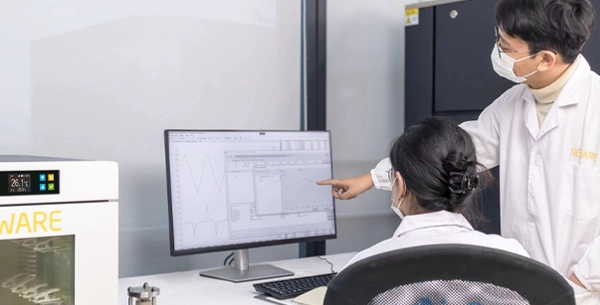
Neware battery testers test your battery performance
About dQ/dV

6. Thermal Safety and Mechanical Properties
| Technique | Abbr. | Analysis Content | Judgment Criteria / Standard |
| Differential Scanning Calorimetry | DSC | Thermal stability of materials (Decomposition temperature). | Cathode decomposition temperature > 200°C. |
| Thermogravimetric Analysis | TGA | Thermal decomposition behavior of components. | No severe weight loss (< 5% at 300°C). |
| Accelerating Rate Calorimetry | ARC | Onset temperature of thermal runaway. | > 150°C (Safety threshold). |
| Nanoindentation | – | Mechanical strength of solid-state electrolytes. | Young’s Modulus > 10 GPa. |
7. Computational and Simulation Techniques
| Technique | Abbr. | Analysis Content | Judgment Criteria / Standard |
| Density Functional Theory | DFT | Electronic structure, adsorption energy, ion migration barriers, and voltage profiles. | Low migration energy barriers; stable adsorption configurations. |
| Molecular Dynamics | MD | Ion transport mechanisms, electrolyte solvation structures, and interfacial evolution. | High ionic conductivity; stable solvation shells (e.g., $Li^+$ coordination). |
| Finite Element Analysis | FEA | Stress/strain distribution, thermal management, and mechanical deformation. | Stress remains below the material’s fracture limit; uniform heat dissipation. |
| Phase-Field Simulation | – | Evolution of microstructure, dendrite growth, and phase transitions. | Suppression of lithium dendrite formation; stable phase boundaries. |
| Machine Learning | ML | High-throughput screening of materials and prediction of battery cycle life. | High prediction accuracy ($R^2 > 0.9$); discovery of novel high-performance materials. |
8. More:
1. Multi-scale Structural Characterization
| Technique | Abbr. | Analysis Content | Judgment Criteria / Standard |
| Focused Ion Beam – Scanning Electron Microscopy | FIB-SEM | 3D reconstruction of electrode/electrolyte microstructure. | Pore connectivity > 90%. |
| Small-Angle X-ray Scattering | SAXS | Analysis of nanoscale pores and particle distribution statistics. | Pore size distribution concentrated between 2–50 nm. |
| Synchrotron X-ray Computed Tomography | SR-CT | Structural evolution of the electrode during charge/discharge. | No lithium dendrites penetrating the separator (Resolution < 1 μm). |
2. Dynamic and Operando Characterization
Characterization Techniques for Battery Materials
| Technique | Abbreviation | Analysis Content | Criteria / Metrics |
| In-situ Mössbauer Spectroscopy | – | Real-time changes in valence states of Fe-based materials | $Fe^{3+}/Fe^{2+}$ ratio fluctuation < 10% |
| In-situ Neutron Depth Profiling | NDP | Quantitative tracking of Li deposition/stripping | Li non-uniform deposition index < 0.3 |
| Cryogenic Electron Microscopy | Cryo-EM | Original morphology of sensitive materials (e.g., Li metal) | Dendrite diameter < 500 nm |
| Time-Resolved X-ray Absorption Spectroscopy | TR-XAS | Dynamics of elemental valence states during charge/discharge | Transition metal valence state response time < 30 s |
3. Targeted Characterization for Specialized Battery Material Systems
For Lithium-Sulfur (Li-S) Batteries:
| Technique | Abbreviation | Analysis Content | Criteria / Metrics |
| In-situ UV-Vis Spectroscopy | UV-Vis | Monitoring the concentration of dissolved polysulfides | Polysulfide concentration < 0.1 mM |
| Sulfur K-edge XANES | – | Evolution of chemical states of sulfur species | Final state Li2S ratio > 85% |
For Solid-State Batteries:
| Technique | Abbreviation | Analysis Content | Criteria / Metrics |
| Contact Resistance Mapping | – | Physical contact at electrode/electrolyte interface | Interfacial resistance < 10 Ohm · cm2 (at 1 MPa pressure) |
| Solid-State Nuclear Magnetic Resonance | ssNMR | Local migration mechanism of lithium ions | Li+ hopping frequency > 10^3 Hz |
4. Integration of Multimodality and Data Science
| Technique | Abbreviation | Analysis Content | Application Case |
| Machine Learning-Aided Spectral Analysis | – | Automated interpretation of high-throughput XPS/EELS data | Rapid identification of SEI component evolution patterns |
| Multiphysics Coupling Simulation | – | Thermal-electrical-mechanical coupled failure analysis | Predicting battery swelling and thermal runaway pathways |
| Digital Twin Model | – | Cross-scale performance mapping (Atom to Device) | Optimizing cathode porosity-ion conductivity relationships |
5. Safety and Failure Analysis
| Technique | Abbreviation | Analysis Content | Criteria / Metrics |
| In-situ Gas Mass Spectrometry | OEMS | Real-time monitoring of gas composition (H2, CO, etc.) | Total gas generation less than 0.1 mL/Ah |
| Infrared Thermal Imaging | IR | Temperature field distribution and thermal runaway propagation | Local temperature difference less than 5 degrees C (at 1C charge/discharge) |
| Acoustic Emission Detection | AE | Dynamics of internal cracking and dendrite growth | High-frequency acoustic signal events less than 10 per cycle |
Supplementary Notes: This supplementary framework further enhances the characterization depth for complex battery systems (such as high-nickel cathodes, silicon-based anodes, and solid-state electrolytes). It also provides more comprehensive data support for failure mechanism analysis and material design.
Dynamic Process Capture: Newly added real-time analytical techniques under operating conditions (such as TR-XAS and in-situ NDP) address the limitations of traditional “static snapshot” characterization.
Sensitive Material Protection: The introduction of Cryogenic Electron Microscopy (Cryo-EM) prevents structural damage to highly active materials, such as lithium metal, during the observation process.
System-Specific Expansion: Targeted characterization solutions have been added to address pain points such as polysulfide shuttling in lithium-sulfur batteries and interfacial contact issues in solid-state batteries.
Data-Driven Optimization: Closed-loop analysis from high-throughput data to performance prediction is achieved through machine learning and multiphysics modeling.
Due to the limited knowledge and English level is inevitable errors and omissions, if there are errors or infringement of the text, please contact me as soon as possible by private letter, I will immediately be corrected or deleted.