
Neware End-of-line (EOL) equipment 2026 update
EOL (End-of-Line) testing is the final testing stage in the battery production process.
Objective: To ensure that every battery pack meets functionality, safety, and performance requirements before leaving the factory.
Testing Goals:
Ensure Product Safety and Reliability: Guarantee that products are safe and reliable upon shipment.
Early Detection of Manufacturing Defects: Identify defects early to reduce the risk of recalls.
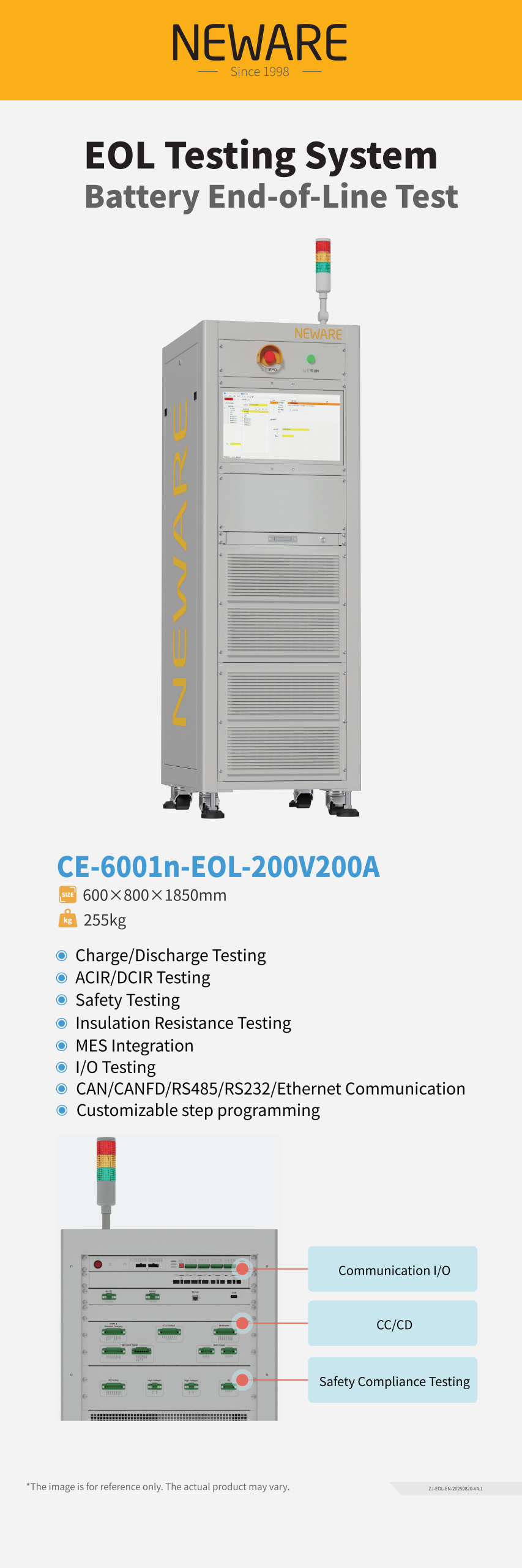
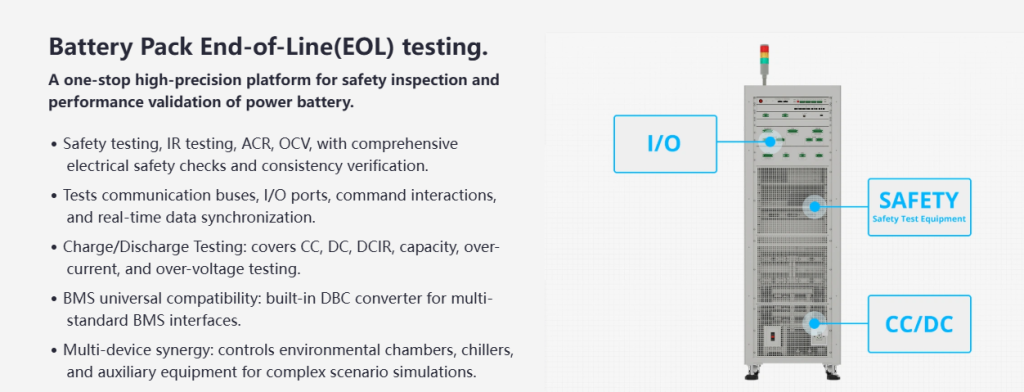
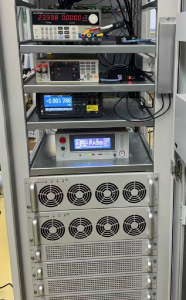
1. EOL Test Equipment List and Functions
| Instrument and Equipment | Test Function Items |
|---|---|
| AC Internal Resistance Tester | AC internal resistance test, Open‑circuit voltage test / OCV |
| Withstand Voltage Tester | AC withstand voltage test, DC withstand voltage test, Insulation resistance test, Ground continuity test, Equipotential test |
| Multimeter | Total voltage accuracy test, High‑precision OCV open‑circuit voltage test, Short‑circuit detection, Relay on‑off test, Pre‑charge relay on‑off test, BMS static power consumption test, BMS operating current test, IDR test, Thermistor resistance test, Heating loop resistance test, CAN resistance test, Capacitance test, Y‑capacitor test, Diode test |
| Charge‑Discharge Module / Charge‑Discharge Equipment | Over‑voltage charge‑discharge test, Over‑current charge‑discharge test, Overload protection test, Battery wake‑up test, SOC calibration test, DCIR / DC internal resistance test, Charge‑discharge cycle test, Polarity detection protection, Reverse‑connection prevention detection protection |
| Programmable Power Supply | Power supply for BMS protection board (36V10A), BMS static power consumption test, BMS operating current test |
| Auxiliary Channel | Cell voltage (single‑string cell) consistency detection, Cell temperature (single‑string cell) consistency detection |
| Temperature‑Humidity Board | Ambient temperature detection, Ambient temperature vs cell temperature comparison test, Humidity detection |
| Insulation Resistance Simulator | Insulation fault simulation test, BMS insulation alarm test |
| Short‑circuit Pulse Tester | Short‑circuit pulse test. This function can be developed upon request. |
| BMS Communication Box (RS485/CAN/CANFD) | Complete machine communication function test, Static communication function detection, Fault detection / fault confirmation / fault code clearing, BMS version number confirmation, Vehicle CAN wake‑up test, Battery cell single‑string voltage reading, Total cell count reading, Cell single‑string temperature reading, Balancing short‑circuit function detection, Read BMS insulation status, SOC adjustment, BMS restart |
| EOL Main Board (Mandatory) | Fast‑charging function test, Slow‑charging function test, Two‑channel PWM output, Vehicle driving dynamic simulation test, Crash test, Service switch test, High‑voltage interlock test, High‑level signal test |
| EOL‑OCP Board (Optional) | IDR test, Thermistor resistance test, Heating loop resistance test, CAN resistance test, OCP over‑current protection delay test |
The battery charge/discharge module portion can be customized. Other components can also be selected from alternative brands. Highly customizable.
There are three models of withstand voltage testers available for selection. Three brands of AC internal resistance testers are available for selection. The model can be chosen based on your budget and battery voltage.
Several core test functions of EOL (End Of Line) equipment:
AC internal resistance test, withstand voltage test, insulation resistance test, DC internal resistance test, over‑voltage & under‑voltage protection test, over‑current protection test, SOC adjustment, communication test (RS232, RS485, CAN, CANFD), high‑voltage interlock test, simulated crash test
2. Introduction to EOL Test Items
Dielectric Withstand Test (HIPOT)
HIPOT (High Potential) Test: A destructive test designed to apply a high voltage—significantly higher than the standard operating voltage—to the Device Under Test (DUT). The purpose is to verify whether the insulation structure can withstand such overvoltage and to detect potential insulation defects, such as insufficient clearances or the presence of impurities. This is one of the most critical tests for electrical safety.
Insulation Resistance Test (IR)
Insulation Resistance (IR) Test: A non-destructive test aimed at measuring the resistance value of insulating materials under a DC voltage. Its purpose is to evaluate whether the quality of the insulation material is sound and to detect if it is affected by moisture, aging, or contamination.
AC Internal Resistance (ACIR) and Open Circuit Voltage (OCV) Measurement
Testing Principle: The instrument generates a constant AC test current (typically very low) and applies it across the battery terminals. By detecting the AC voltage drop across the battery and applying Ohm’s Law (Z = V / I), the instrument calculates the battery’s AC internal resistance (ACIR).
| Function | Measurement Object | Objective |
| DC Voltage Measurement | Total Voltage, Series Voltage, BMS Supply Voltage | Verify basic output, cell balancing, and BMS operating conditions |
| Continuity Test | Fuses, Connectors, Wiring Harnesses | Troubleshoot open circuits and verify assembly integrity |
| Resistance Measurement | Connection points, Circuits | Rough assessment of connection reliability |
| Current Measurement | Standby Current | Verify BMS sleep mode power consumption |
By utilizing communication functions, the test system transitions from passive measurement to active interaction, enabling the verification of whether the BMS is functioning correctly.
If you want to know more information about Neware EOL testing equipment, please feel free to contact Neware!
Due to the limited knowledge and English level is inevitable errors and omissions, if there are errors or infringement of the text, please contact me as soon as possible by private letter, I will immediately be corrected or deleted.