
Advanced Battery Characterization: From Initial Formation to Dynamic HPPC test
In the competitive landscape of energy storage, precision in testing is the bridge between a prototype and a market-leading product. Understanding how a battery behaves during its initial life stages, under constant voltage maintenance, and during high-stress pulse events is essential for safety and longevity.
1. Battery Formation and Capacity Grading (Formation & Grading)
The initial charge-discharge cycle, often referred to as Battery Formation or Capacity Grading, is the most critical step in cell manufacturing. This process is not merely about measuring stored energy; it is the fundamental “activation” phase where the Solid Electrolyte Interphase (SEI) layer is established.
Addressing Consistency and Performance Challenges:
Mitigating Capacity Disparity: Even in high-precision manufacturing, slight variances in electrode coating or electrolyte wetting can lead to capacity fluctuations. Industry leaders use advanced statistical modeling (Mean and Standard Deviation) to categorize cells into specific “grades,” ensuring that battery packs are built with perfectly matched components.
Enhancing Coulombic Efficiency: Low efficiency during initial cycling often points to parasitic side reactions. By optimizing cycling protocols and electrolyte additives, manufacturers can stabilize the electrode-electrolyte interface, ensuring the cell maintains its rated capacity over thousands of cycles.
Accelerated Aging Analysis: To bypass the months required for standard life-cycle testing, engineers employ accelerated aging protocols—subjecting cells to elevated temperatures to predict long-term degradation and structural stability.
2. Floating Charge Analysis: Evaluating Long-Term Voltage Stability
Many applications, such as Uninterruptible Power Supplies (UPS) and certain grid-backup systems, require batteries to remain at a Constant Voltage (CV) for extended periods. This is evaluated through the Floating Charge Test.
Technical Hurdles in Float Applications:
Thermal Runaway and Overcharging: If a charging system lacks precise current regulation, continuous float charging can trigger electrolyte loss. Implementing multi-stage voltage control is vital to keep the cell within its “safe-operating window.”
Managing Voltage Drift: Internal resistance changes and self-discharge rates can cause a cell’s voltage to wander. Continuous monitoring and micro-adjustments in charging current are necessary to maintain a steady-state float voltage.
Combating Passivation: Long-term exposure to constant high voltage can lead to electrode passivation or electrolyte decomposition. Intermittent “refresh” cycles—brief discharge/charge events—are often programmed to maintain the electrochemical activity of the cell.

3. Hybrid Pulse Power Characterization (HPPC)
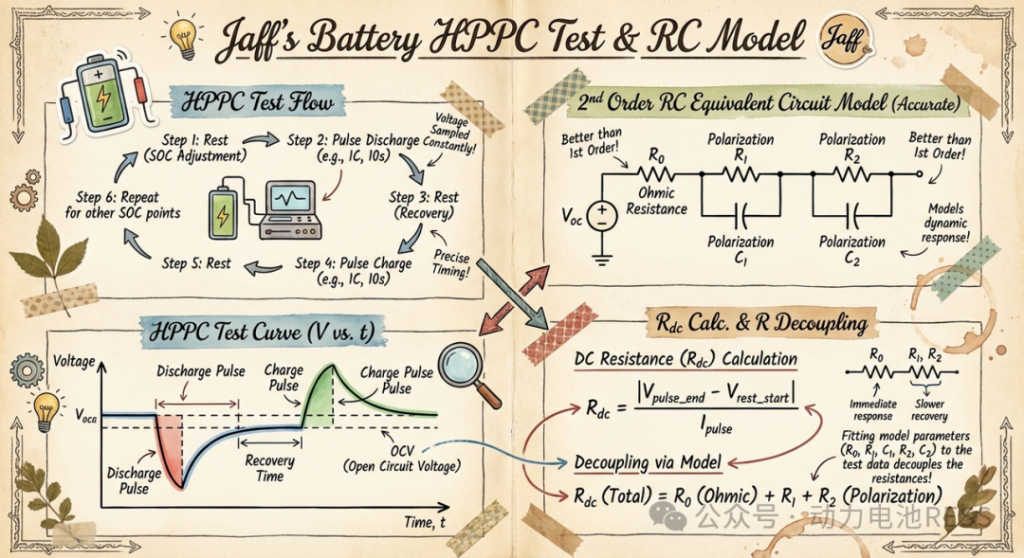
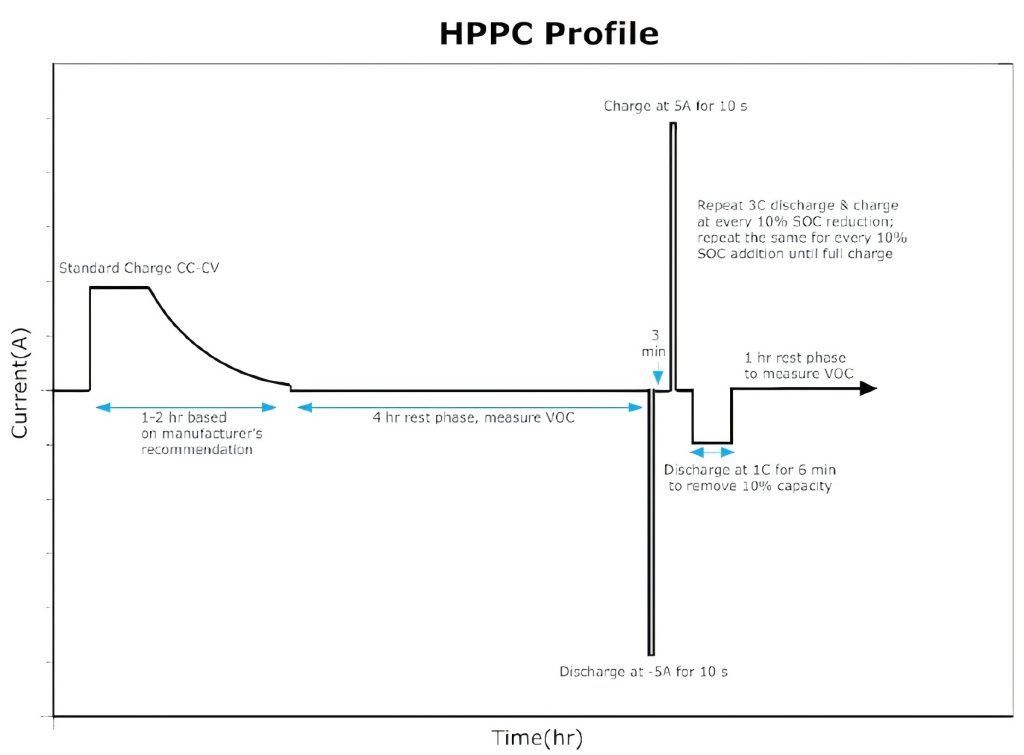
The HPPC test is the gold standard for mapping the dynamic power envelope of a battery. By subjecting the cell to high-frequency current pulses, engineers can simulate the aggressive load variations seen in Electric Vehicle (EV) powertrains.
Solving the Complexities of Pulse Testing:
Thermal Management: High-current pulses generate rapid joule heating. Using high-precision temperature sensors and cooling synchronization is essential to prevent safety risks and data skewing.
Transient Voltage Response: Rapid pulses cause “Voltage Sag.” Measuring this accurately allows BMS designers to set safe discharge limits and prevent system-level brownouts.
Resistance & Power Fade: Repeated pulse stresses can accelerate mechanical strain on electrodes. HPPC data allows for the calculation of DCIR (Direct Current Internal Resistance), the primary metric for tracking “Power Fade” as a battery ages.
Featured Solution: Revolutionize Your HPPC Testing with Neware BTS 6000 Pro
Precision and speed are the cornerstones of advanced EV battery research. The Neware CE-6016-Pro-5V100A is engineered to meet the rigorous demands of next-generation cell characterization. With a 16-channel configuration and an ultra-high accuracy of ±0.02% FS, this system delivers the data integrity required for critical R&D.
Why settle for standard when you can achieve excellence in HPPC testing?
Rapid Dynamics: Achieve a current response time of ≤1ms and a seamless conversion time of ≤2ms (from -90% to 90% FS).
High-Speed Insights: A 200Hz recording frequency combined with a 10ms minimum pulse width ensures you never miss a transient voltage drop.
Scalable Power: Need more juice? Support for 8-channel parallel mode allows you to reach up to 800A effortlessly, providing the flexibility needed for high-power battery simulations.
From drive cycle simulations to complex pulse characterization, the BTS 6000 Pro is the ultimate tool for EV battery innovation.
Conclusion: The Path to Reliable Energy Storage
From the initial Formation stage to the rigorous demands of HPPC dynamic profiling, comprehensive testing is the only way to ensure battery reliability. By identifying potential failure modes—such as voltage drift, capacity fade, and thermal spikes—during the testing phase, manufacturers can optimize their designs for the high-performance demands of the modern world.
Whether you are developing consumer electronics or long-range EV battery cells, utilizing high-precision equipment like the Neware BTS 6000 series ensures that your data is accurate, repeatable, and globally compliant.