
When I asked Google Gemini, how to set GITT test for lithium-sulfur batteries and how to set them on Neware battery testing system?
Its answer is:
For Lithium-Sulfur (Li-S) batteries, the GITT test is more complex than standard intercalation materials because of the liquid-to-solid phase transitions. Below is the guide for parameter settings and the configuration process in the Neware BTS software.
I. GITT Parameter Design for Li-S Batteries
Unlike Li-ion batteries, Li-S cells involve the shuttle effect and viscosity changes in the electrolyte. Therefore, the parameters must be set to capture the equilibrium potential accurately.
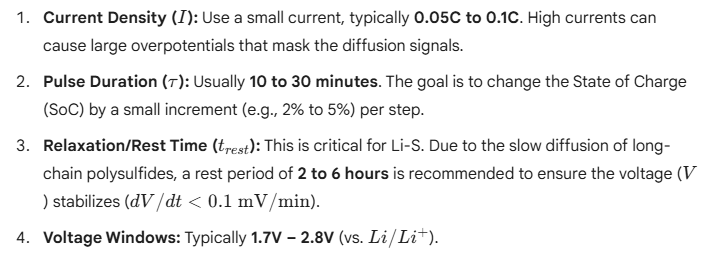
And 5. Data Logging: Every 5 – 10 seconds or Delta V = 2mV.
II. Setting Up in Neware BTS Software
In the Neware BTS (Battery Testing System) software, you use the “Jump” function to create a loop of Pulse + Rest.
Step-by-Step Programming Table
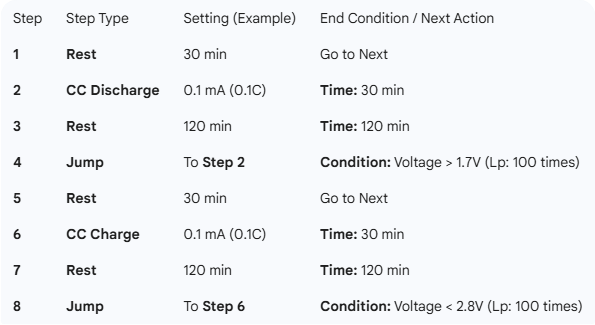
Detailed Logic:
The Loop: The “Jump” command tells the machine: “If the battery hasn’t reached 1.7V yet, go back to the discharge step and do another 30-minute pulse.”
Record Frequency: Go to the “Record Settings” tab. Set the time interval to 5s or 10s. You need high-density data during the first 60 seconds of the relaxation period to calculate the diffusion coefficient (DLi+).
III. Practical Tips for Li-S GITT
- Pre-cycling: Run 2-3 standard charge/discharge cycles at 0.1C to stabilize the SEI and ensure electrolyte wetting.
Temperature Stability: Li-S batteries are highly sensitive to temperature. Conduct the test in a thermal chamber at a constant 25°C. ——->Neware 0~60℃ chamber
Electrolyte/Sulfur Ratio (E/S): Note your E/S ratio in your report, as low E/S ratios significantly slow down polysulfide diffusion, requiring longer rest times.
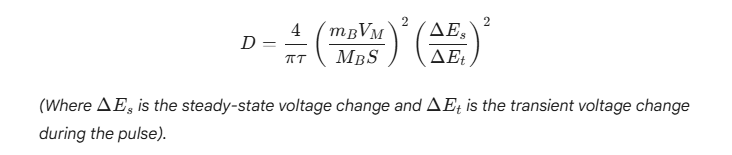
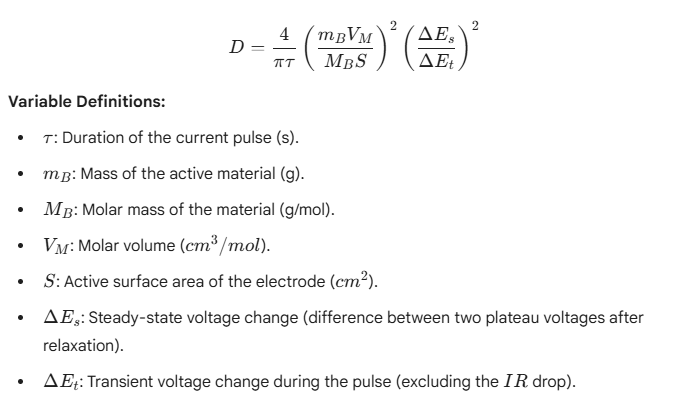
Data Analysis: When calculating the diffusion coefficient (D), remember that the formula assumes a semi-infinite diffusion model:
And Data Export Guide:
- Naming Convention: Save the test as “Li-S_GITT_0.1C_Pulse30min_Rest2h”.
- Data Export: Export the data in .CSV or .XLS format. Ensure “Step Time”, “Voltage”, “Current”, and “Capacity” columns are selected.
- Analysis Variables:
- Transient Voltage Change: The voltage shift during the 30-minute pulse (after the initial IR drop).
- Steady-State Voltage Change: The difference between the starting voltage of the pulse and the voltage at the end of the 2-hour rest period.
I asked a friend of mine who does battery research, and he said the answer was correct, and he shared more information with me.
The parameter settings referenced the article published by Professor Qiang Zhang‘s team in April 2025 – Two-Stage Solvation of Lithium Polysulfides in Working Lithium–Sulfur Batteries (because the parameters I tested were quite special and not universally applicable, I did not choose my own).
Please set the test parameters according to your battery materials!!!The content shared here is for reference only!!!
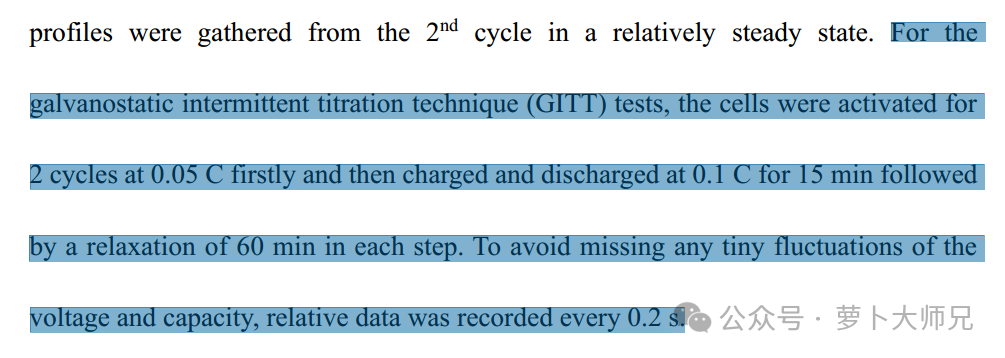
Parameters: The assembled full cell was activated twice at 0.05C, and then charged and discharged at 0.1C for 15 minutes. The relaxation time for each step was 60 minutes, and data was recorded every 0.2 seconds.
Set them on Neware BTS
The active material is 1.153 mg, and the nominal specific capacity is 1650 mAh/g. (Please fill in the information based on your battery material.)
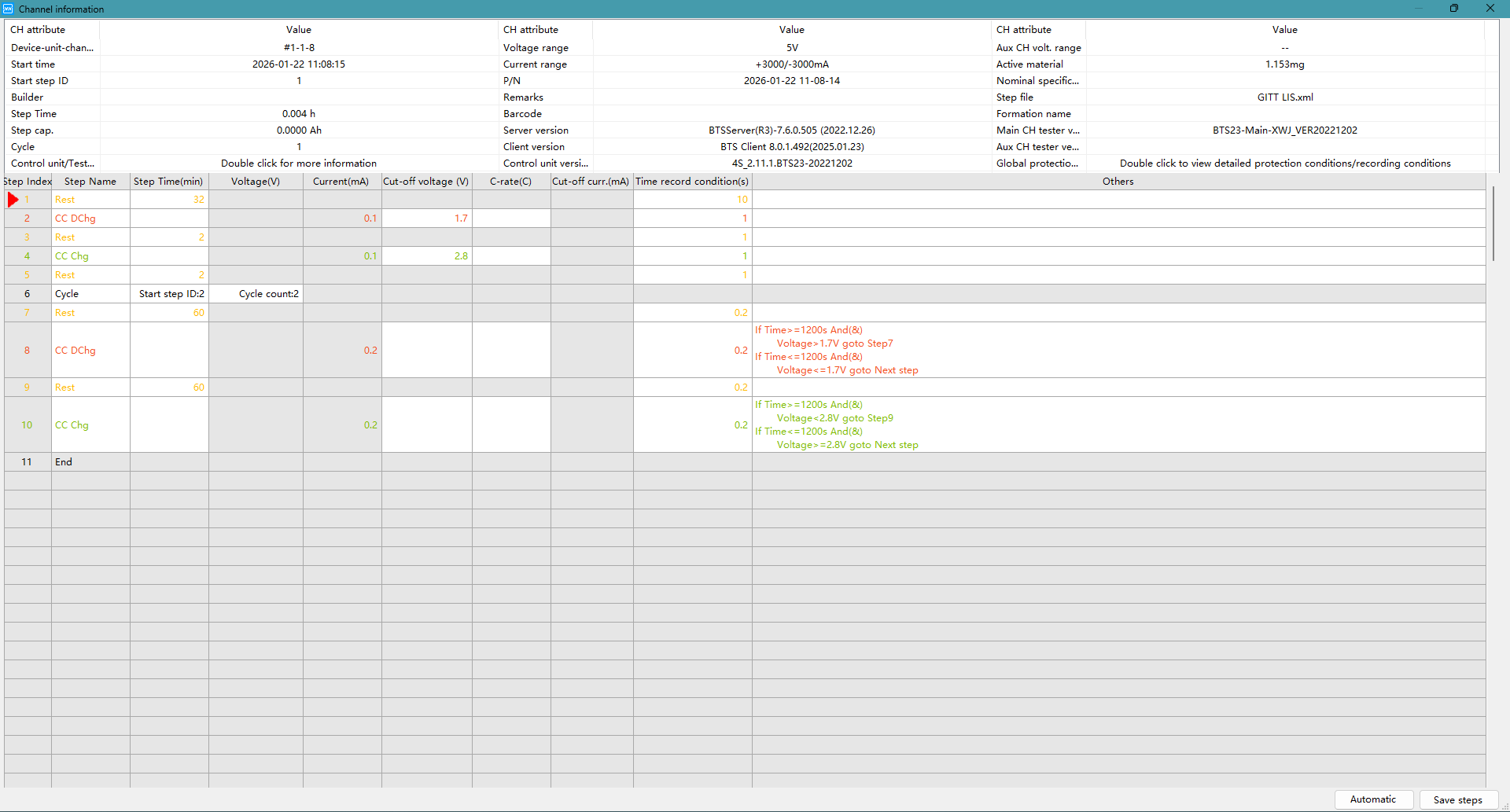
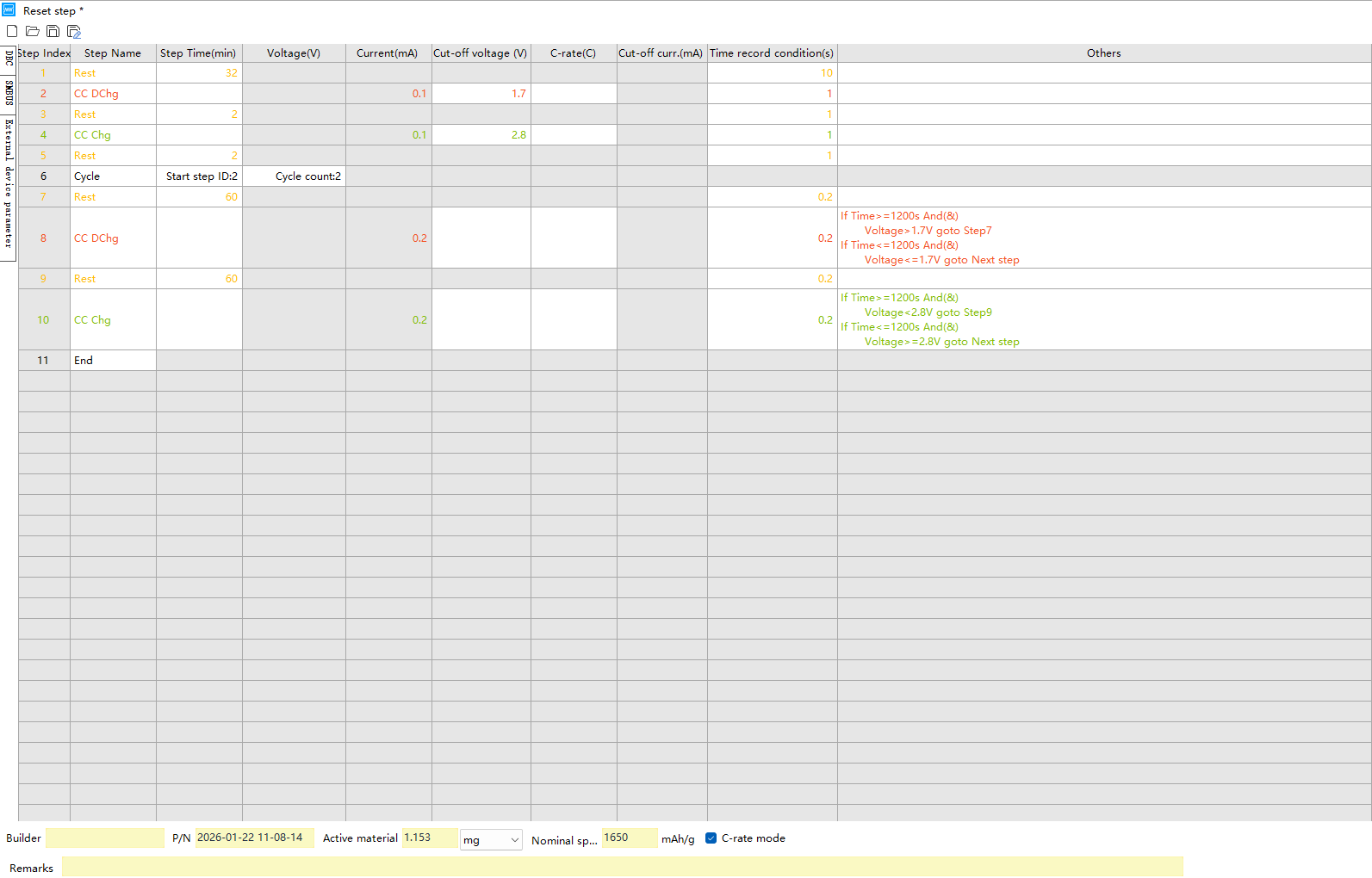
The first step is rest, and steps 2-6 are activation steps, with parameters set the same as in a regular cycle.
Step 7, resting, begins the parameter settings for the GITT test. The resting time here is the relaxation time (60 minutes).
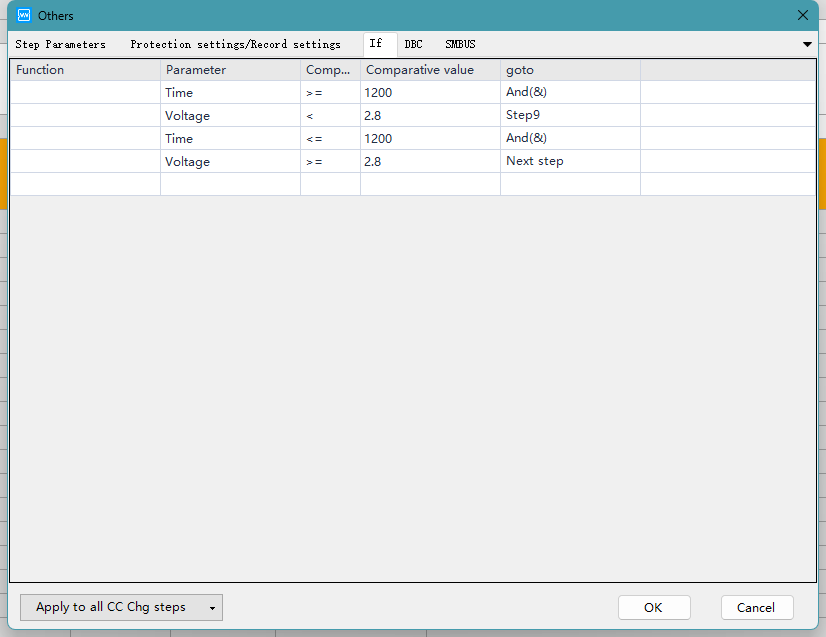
Step 8 is the constant current discharge process, with the rate set to 0.1C and the recording time set to 0.2s. Then, click “Other” to enter the page shown in Figure 3, and then enter the “If” interface. Set the parameters as shown in the figure. The control process is described as follows: if the discharge time is greater than or equal to 1200s and the voltage is greater than 1.7V, it jumps to step 7 (i.e., 1-hour relaxation); if the time is less than 1200s and the voltage is less than or equal to 1.7V, it jumps to the next step – after another 1-hour relaxation, it enters step 10, the constant current charging process.
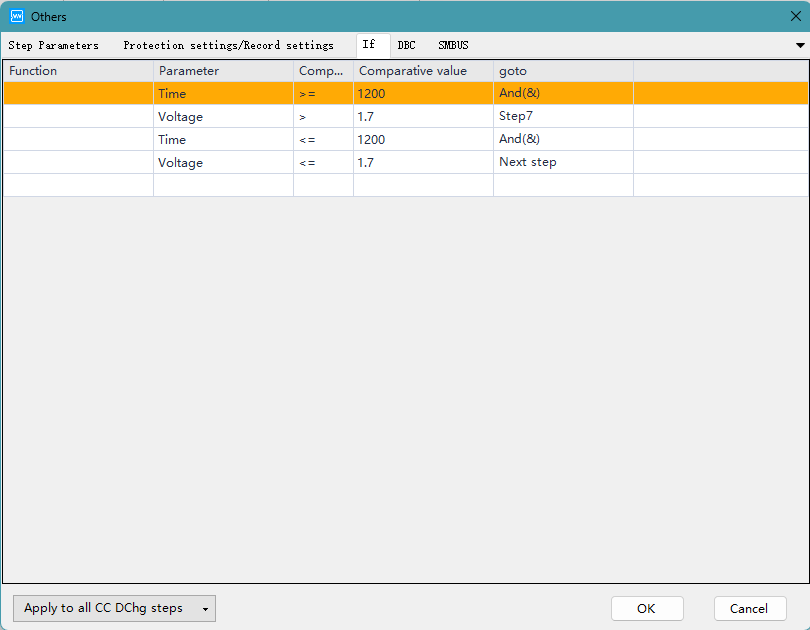
The constant current charging rate is also set to 0.1C, and the recording time is 0.2s. Then, enter other settings interface and set the parameters as shown in Figure 4. Its control process is described as follows: if the discharge time is greater than or equal to 900s and the voltage is less than 2.8V, it jumps to step 9 (relaxation for 1h); if the time is less than 900s and the voltage is greater than or equal to 2.8V, it jumps to the next step (end GITT test).
Data processing and its application in lithium-sulfur batteries
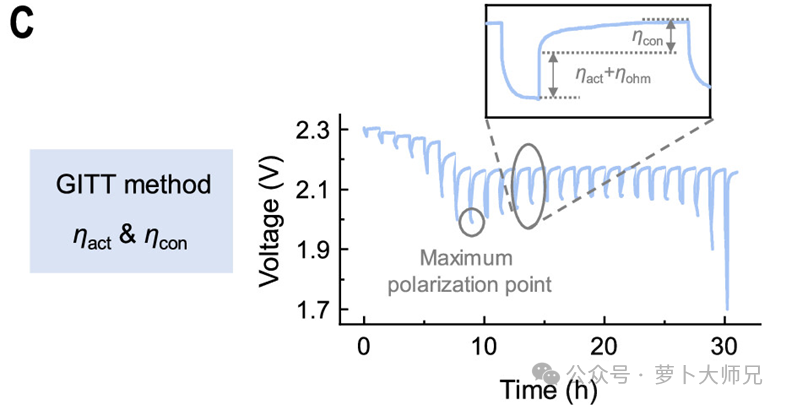
Our tests directly yield the time-voltage curve shown in the image below. We can export the time-voltage data and plot it in Origin. Furthermore, by processing this time-voltage data (combining parameters and the properties of the sulfur cathode), we can obtain the lithium-ion diffusion coefficient data during this GITT test. This processing was previously very cumbersome, but editor Tan developed a small calculation software that makes the calculation much easier. If you are not using the Neware test channels, you can choose to use that software for calculation; if you are using the Neware battery cyclers, the Neware BTS software can process and obtain the data.
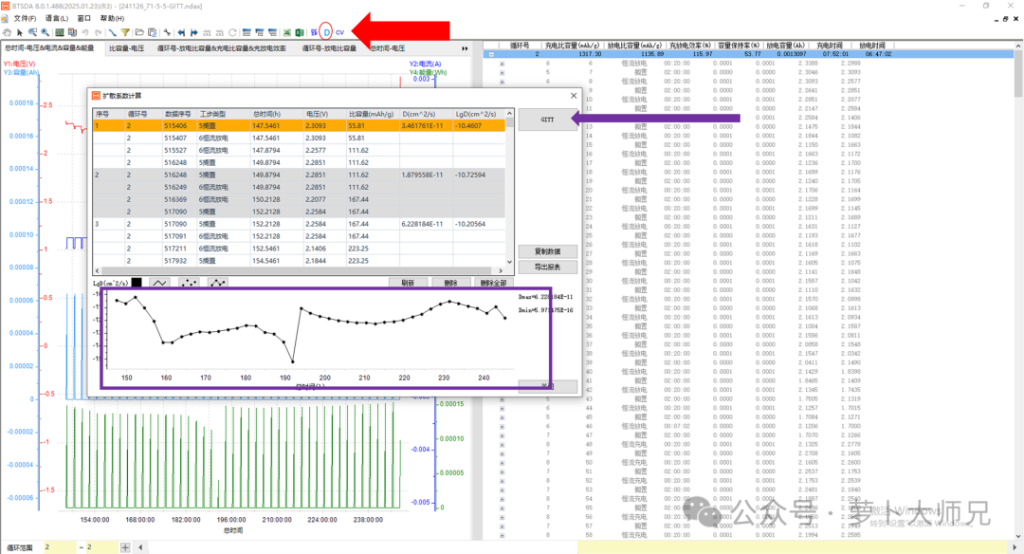
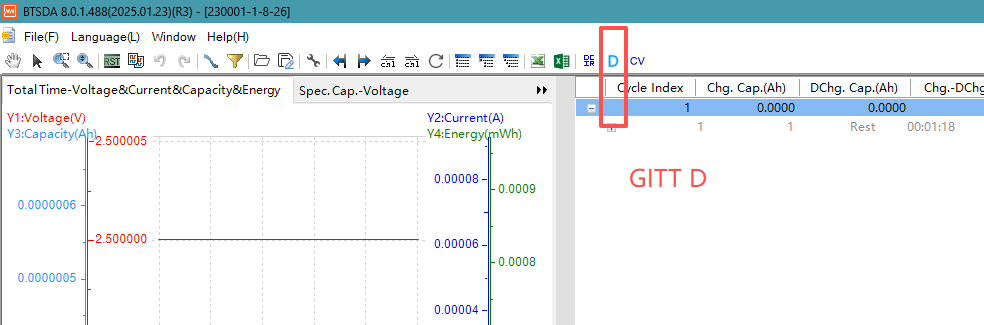
As shown in the figure, this is the data from my previous test. Clicking the “D” within the small red circle indicated by the arrow will open this calculation page. Since my parameters are already set, the data is directly displayed (within the purple frame). Clicking the GITT button indicated by the purple arrow will take you to the parameter settings interface. Here, I chose to calculate using Vm (molar volume), where mB (g) is the mass of sulfur (converted to grams), MB (g/mol) is the relative atomic mass, and S (cm²) is the area of the positive electrode. The cycle range should be 3-3 according to the above procedure (I only activated one cycle, so it’s 2-2). Finally, click “Export Report” to get the data and plot it.
If your battery is a lithium iron phosphate battery, you only need to change a few parameters. Parameters: The assembled full cell was activated once at 0.1C, and then charged and discharged at 0.1C for 20 minutes. The relaxation time for each step was 120 minutes. Data was recorded every 1 second. The voltage range was 2.2-4.2 V.
The information above is for reference only. Each person researches different battery materials, and the setting parameters will need to be adjusted accordingly.
Due to the limited knowledge and English level is inevitable errors and omissions, if there are errors or infringement of the text, please contact me as soon as possible by private letter, I will immediately be corrected or deleted.
More tips:
Neware test templates save your time. GITT template.
4 formulas for calculating the GITT diffusion coefficient
Design, Assembly, and Testing of Full Coin Cells: Tutorials and Case Studies 2026 post