
Prof. Yunhui Huang’s Group Leads the Way in Battery Innovation: Key Research Highlights (2025)-3
21. eScience: Electron beam irradiation for spent LiFePO4 recycling
The research team led by Prof. Yunhui Huang and Prof. Yue Shen proposed a direct recycling strategy for lithium iron phosphate (LiFePO4, LFP) based on electron beam irradiation (EBI). The electron beam irradiation selectively degrades the polymeric binders, enabling the highly efficient delamination of LFP from the current collectors.
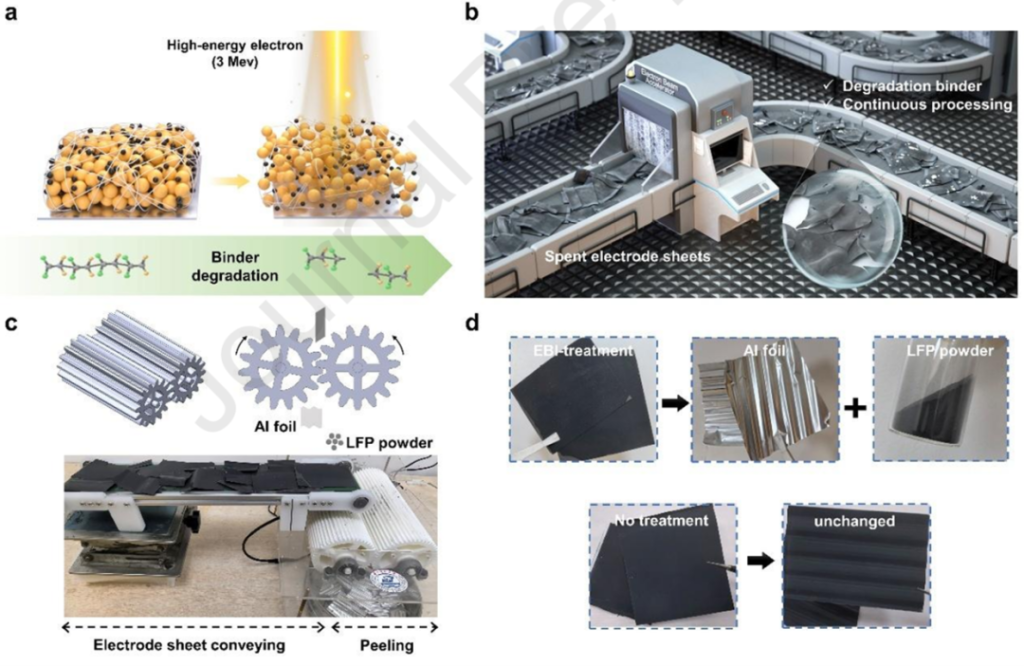
Electron beam irradiation for spent LiFePO4 recycling
eScience
22. Electrochemical Energy Reviews: Advancements, Challenges, and Future Trajectories in Advanced Battery Safety Detection
The review presented by the research team of Prof. Yunhui Huang and Prof. Ming Xu from Huazhong University of Science and Technology begins with a systematic analysis of the root causes and failure mechanisms underlying safety issues in lithium-ion batteries. It further examines the intricate correlations and reciprocal influences among various factors to elucidate the complex and unpredictable challenges facing battery safety. The study focuses on the customization of Artificial Intelligence (AI) and Intelligent Battery Management Systems (BMS) designed to manage the complexity of large-scale battery packs. These systems aim to achieve real-time monitoring and predictive maintenance, thereby preventing catastrophic failures.
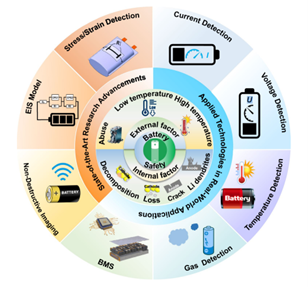
Advancements, Challenges, and Future Trajectories in Advanced Battery Safety Detection
Electrochemical Energy Reviews (2025) 8:10
23.Review of Materials Research: Progress and perspectives on molecular design of crosslinked polymer electrolytes for solid-state lithium batteries
The research team led by Prof. Yunhui Huang provides a comprehensive review of the recent advances in cross-linked solid polymer electrolytes (SPEs) for solid-state lithium batteries (SSLBs). The review details the classification of cross-linking monomer selections and their corresponding reaction types. At the molecular level, a systematic analysis is conducted on the fundamental relationships between cross-linked architectures and their resulting physical and electrochemical properties. Finally, the study outlines the current challenges and future perspectives of cross-linked SPEs in this rapidly evolving field.
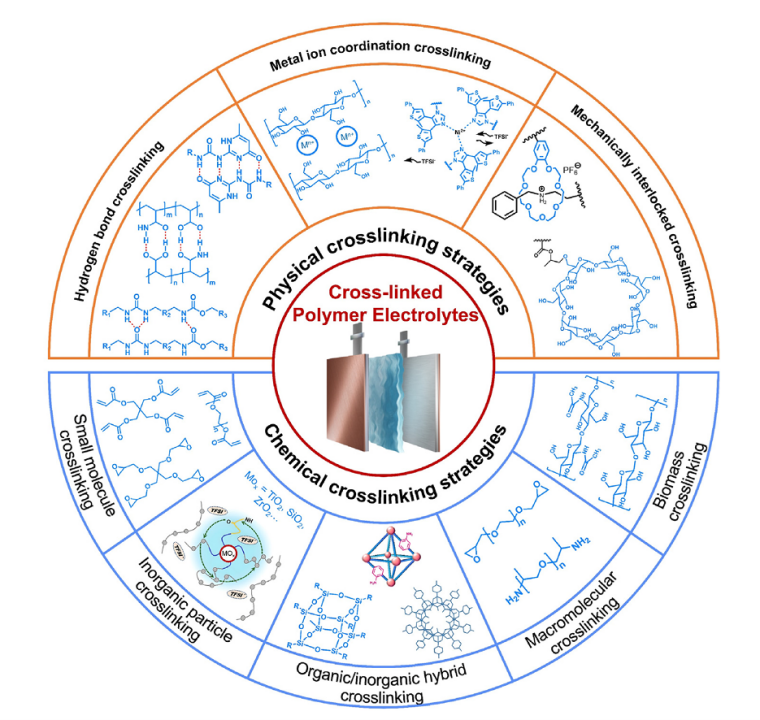
Review of Materials Research 1 (2025) 100013
24. Advanced Functional Materials: Heatable Polymer Current Collectors for Cold-Climate Battery Operation
The research team led by Prof. Yunhui Huang and Prof. Henghui Xu from Huazhong University of Science and Technology has innovatively designed a multilayer composite current collector structure. The core consists of a polyimide/carbon nanotube (PI/CNTs) Joule heating layer sandwiched between two insulating polyimide (PI) layers. The outermost surfaces are coated with two highly conductive metallic layers deposited via magnetron sputtering.
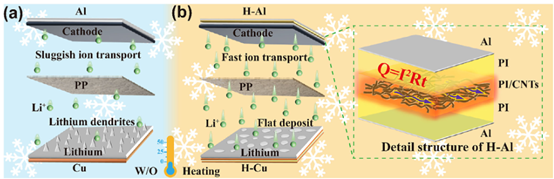
Heatable Polymer Current Collectors for Cold-Climate Battery Operation
Adv. Funct. Mater. 2025, e14172
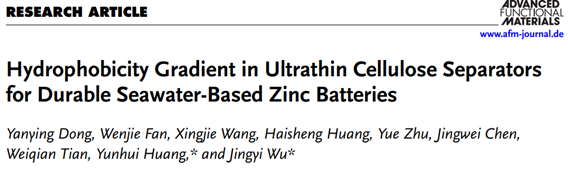
25.Advanced Functional Materials: Hydrophobicity Gradient in Ultrathin Cellulose Separators for Durable Seawater-Based Zinc Batteries
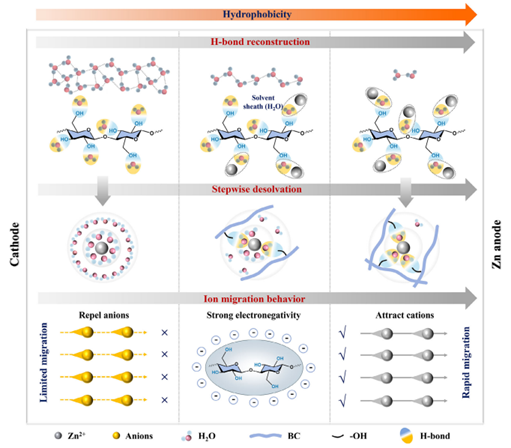
The research team led by Professor Yunhui Huang from Huazhong University of Science and Technology and Professor Jingyi Wu from the Ocean University of China has developed a gradient hydrophobic cellulose membrane (gBC) with a thickness of only 18 μm. By leveraging the synergistic effect of the hydrophobic gradient and a negatively charged surface, this membrane successfully suppresses Cl⁻ permeation and reduces interfacial water activity.
Hydrophobicity Gradient in Ultrathin Cellulose Separators for Durable Seawater-Based Zinc Batteries
Adv. Funct. Mater. 2025, e13685
26.Energy Storage Materials: High-efficiency NaCl presodiation agent for sodium-ion batteries
The research team led by Prof. Yunhui Huang and Prof. Zhen Li from Huazhong University of Science and Technology, in collaboration with Prof. Pei Hu from Hubei University of Technology, has developed sodium chloride (NaCl) as a low-cost, non-toxic, and highly efficient presodiation agent for sodium-ion batteries. The NaCl/Ketjen Black (NaCl/KB) composite, prepared via a ball-milling method, achieves a significant presodiation capacity of 457 mAh g⁻¹ at a potential below 4.2 V.
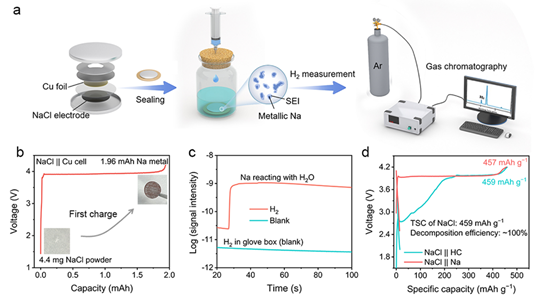
High-efficiency NaCl presodiation agent for sodium-ion batteries
Energy Storage Materials 81 (2025) 104500
Prof. Yunhui Huang’s Group Leads the Way in Battery Innovation: Key Research Highlights (2025)-1
Prof. Yunhui Huang’s Group Leads the Way in Battery Innovation: Key Research Highlights (2025)-2