What is Bipolar Stacking in Solid-State Batteries (SSB)?
Source: WeChat Official Account “Battery Classroom”
Bipolar Stacking is widely regarded as the “secret weapon” for Solid-State Batteries (SSB) to unlock superior energy densities and high-voltage performance.
While conventional liquid lithium-ion batteries are limited by monopolar cell architectures, solid-state technology enables a highly efficient bipolar design, fundamentally transforming how power is integrated within the cell.
Bipolar stacking in solid-state batteries represents an innovative architecture designed to elevate system voltage and energy density by stacking multiple electrochemical cells in series. This approach simultaneously minimizes the use of inactive materials and streamlines the overall packaging design.
By utilizing a shared current collector—which functions as the anode for one cell and the cathode for the adjacent cell—this design eliminates the need for redundant external interconnects and additional packaging materials commonly found in traditional battery configurations.
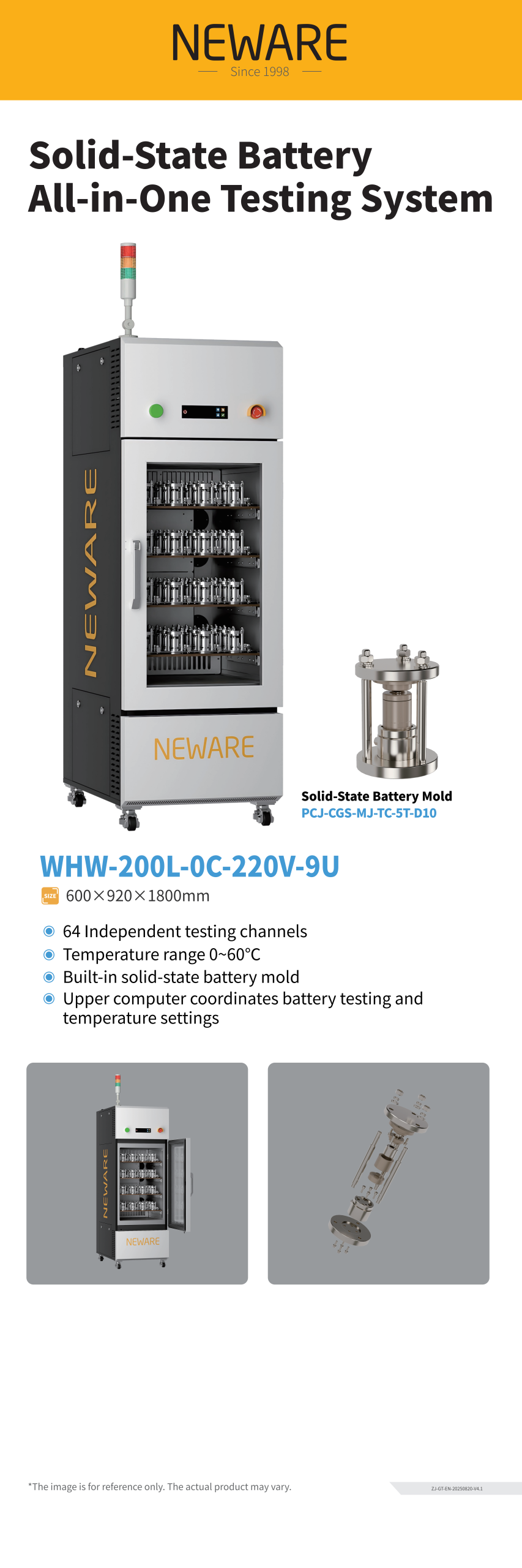
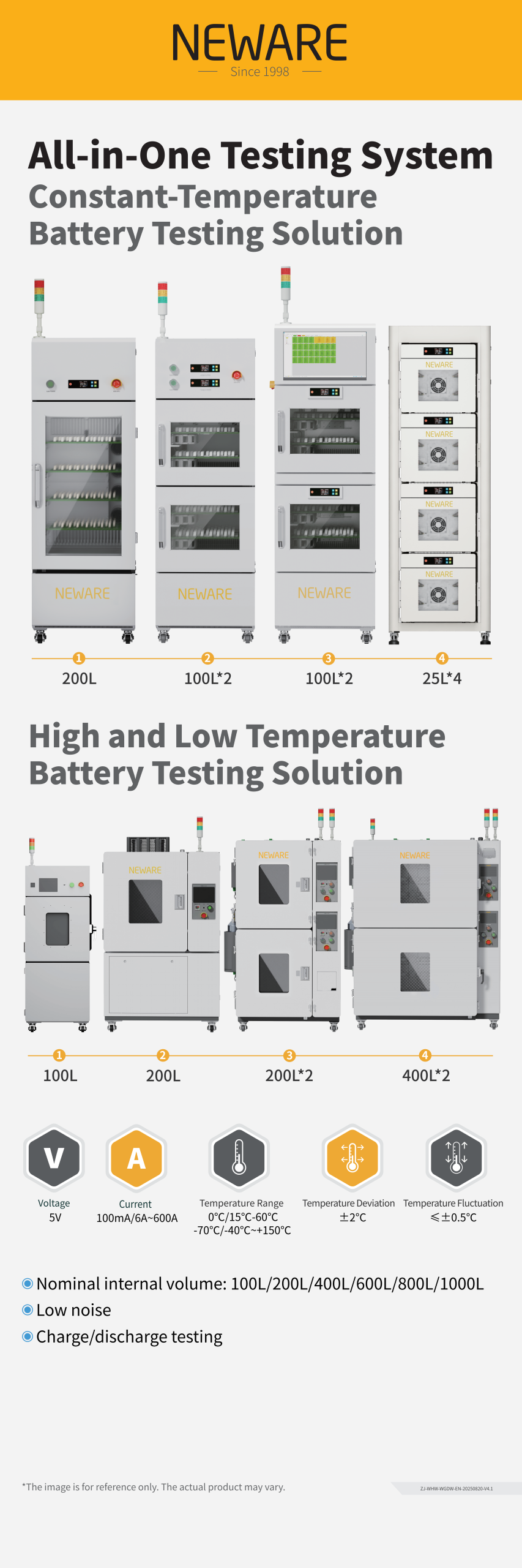
Test your Solid-State Batteries
Concepts and Principles of Bipolar Stacking
In conventional battery packs, individual cells are typically interconnected in series or parallel via external wiring and busbars. This traditional configuration introduces significant parasitic weight, excess volume, and increased system complexity.
In contrast, bipolar batteries utilize a streamlined architecture where cells are directly connected in series by coating active materials on both sides of a bipolar current collector. Specifically, one side of the collector functions as the cathode (coated with positive active material), while the opposite side serves as the anode (coated with negative active material).
This “all-in-one” integrated design substantially reduces the ratio of inactive components—such as interconnects, tabs, and individual cell housings—thereby maximizing both the gravimetric energy density (Wh/kg) and volumetric energy density (Wh/L) of the entire battery system.
For instance, the figure below illustrates the structural schematic of an oxide-based all-solid-state lithium battery (ASSB), demonstrating the operational principles of a high-efficiency bipolar stack.
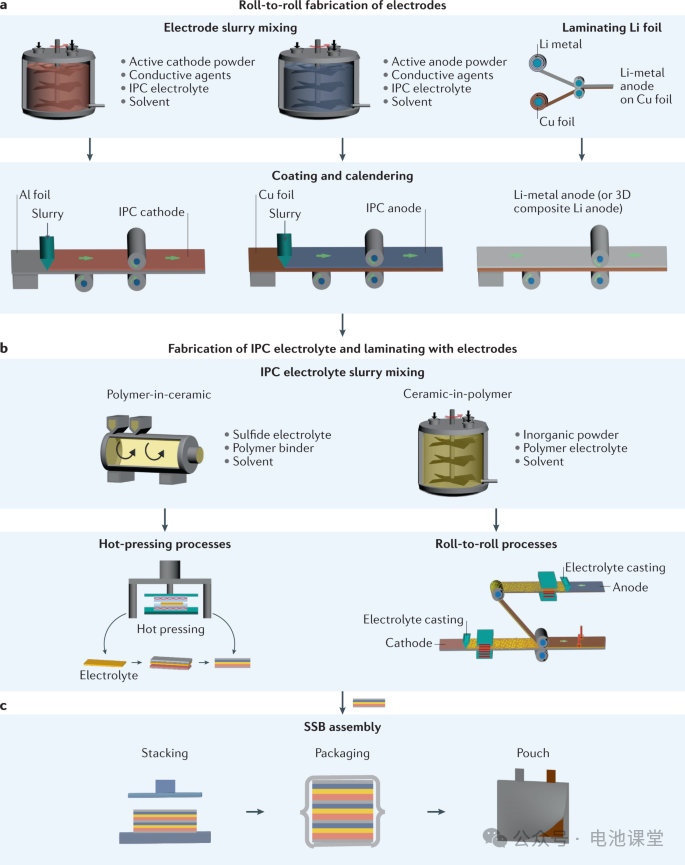
The bipolar design enables battery modules to achieve higher total output voltages while simplifying thermal management, as the internal series connection mitigates heat generated by contact resistance in external interconnects.
Furthermore, the integration of solid-state electrolytes (SSEs) provides distinct advantages for bipolar stacking. Their non-flammable nature significantly enhances safety and facilitates the use of high-energy-density electrode materials. Additionally, the high shear modulus of solid electrolytes physically suppresses lithium dendrite growth—a critical safety hazard inherent in traditional liquid-electrolyte systems.
Applications of Bipolar Stacking in Solid-State Batteries
Bipolar stacking technology demonstrates immense potential in All-Solid-State Batteries (ASSBs), primarily because solid electrolytes effectively resolve the internal short-circuiting issues that traditional liquid-electrolyte cells face in a bipolar configuration. In ASSBs, the solid-state electrolyte replaces both the flammable organic liquid electrolyte and the separator, thereby enhancing inherent safety and enabling significantly higher energy densities.
Sulfide-based solid electrolytes are among the critical materials for achieving high-voltage, high-energy-density bipolar ASSBs. Research indicates that by optimizing the fabrication processes of both the sulfide electrolytes and the electrodes, multi-layer bipolar stacked cells can be successfully produced, leading to a substantial leap in energy density.
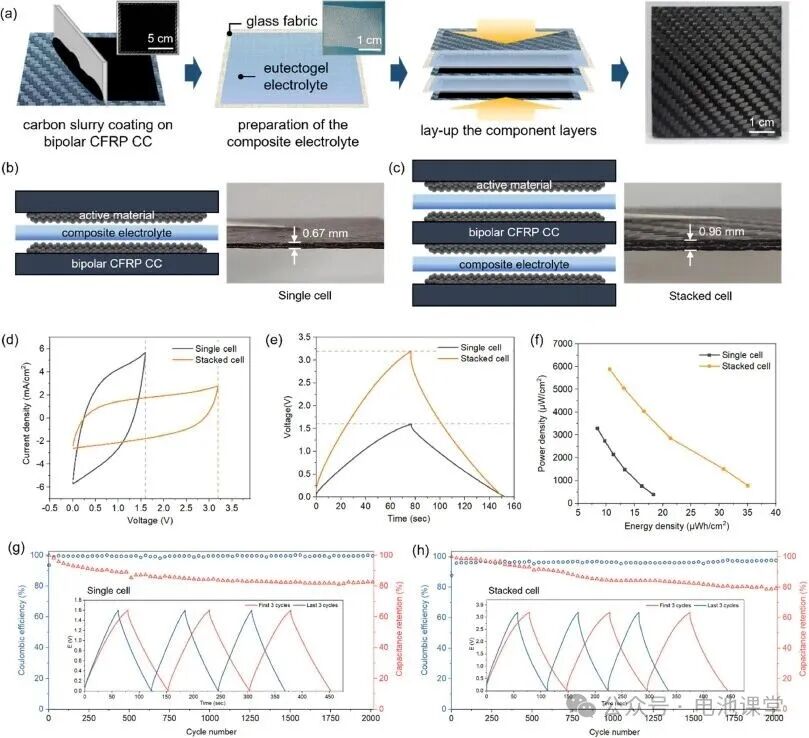
Beyond ASSBs, bipolar stacking is also applicable to other advanced battery chemistries, such as wearable aluminum batteries. For instance, Carbon/Polyethylene Films (CPF) can serve as bipolar plates, facilitating the development of wearable bipolar aluminum batteries with enhanced energy storage capacity. Furthermore, Carbon Fiber Reinforced Polymer (CFRP) current collectors have been developed for structural energy storage composites. These materials offer a specific strength far exceeding that of traditional metallic collectors and can function as an integral component of the bipolar electrode.
As illustrated in the figure below, CFRP is utilized as a bipolar current collector to enable the stacking of multifunctional energy storage composites.
In practical applications, bipolar all-solid-state lithium batteries are considered the ideal candidate for achieving high voltage and high energy density in large-scale power storage, such as electric vehicles (EVs) and stationary energy storage systems (ESS). Notable research in Japan has successfully fabricated bipolar stacked batteries based on quasi-solid-state electrolytes, verifying their high-voltage operational performance.
Challenges and Future Prospects
Despite the significant advantages of bipolar solid-state batteries, several challenges must be overcome for full commercialization:
1. Interfacial Stability Issues
Poor solid-solid contact within the cell is a critical bottleneck for power performance. Chemical/electrochemical instability and mechanical contact issues between the electrodes and the solid electrolyte lead to high interfacial resistance, limiting cycle life and C-rate performance. For instance, the inherent rigidity of NASICON-type electrolytes (e.g., LATP) can result in insufficient contact with electrodes unless high-temperature processing is employed to improve the interface.
2. Stack Pressure Management
Solid-state lithium metal batteries are highly sensitive to external pressure during both manufacturing and operation. Stack pressure influences the intrinsic properties of the electrolyte and the stability of the electrode/electrolyte interface. It is crucial for suppressing lithium dendrite formation and maintaining contact; however, pressure fluctuations during cycling can lead to mechanical fatigue and material degradation.
3. Manufacturing Complexity and Cost
Scalable, low-cost production remains a hurdle. While bipolar architecture simplifies the overall system, manufacturing multi-layer bipolar electrodes with consistent, high-quality interfaces is extremely difficult—particularly for sulfide electrolytes. Additionally, preparing certain electrolytes, such as garnet-type oxides, involves complex material design challenges.
4. Material Compatibility
There is an urgent need for solid electrolytes with high ionic conductivity, wide electrochemical windows, and excellent electrode compatibility. For example, silicon-based anodes undergo massive volume expansion (>300%) during charge/discharge, which can cause irreversible degradation of the electrode/electrolyte interface.
Future Research Directions
To unlock the full potential of bipolar stacked batteries, research is shifting toward:
Interface Engineering: Utilizing interface modification, thin-film technologies, or in-situ ionogel formation to improve physical contact and chemical stability, thereby reducing resistance.
Novel Bipolar Current Collectors: Exploring lightweight, flexible, and highly conductive materials, such as Bipolar Textile Composite Electrodes (BTCE), to enhance energy density and flexibility for wearable electronics.
Advanced Manufacturing: Developing low-cost, large-scale processes like slurry casting and roll-to-roll (R2R) processing to facilitate commercialization.
Multiphysics Coupling Models: Leveraging Digital Twins and multiphysics modeling to predict performance and failure modes. This allows for the synergistic management of electrochemical, thermal, and mechanical behaviors within the cell.
Electrolyte Innovation: Continuing the development of electrolytes with superior ionic conductivity and interface stability, such as advanced phosphate-based NASICON structures.
Conclusion
Overall, the bipolar stacked solid-state battery stands as a highly promising next-generation energy storage technology. It is poised to deliver breakthrough improvements in safety, energy density, and simplified packaging. As material science and battery engineering continue to advance, these challenges will be mitigated, paving the way for widespread application in EVs, portable electronics, and grid-scale storage.
Original Statement: This article was interpreted and authored by “Battery Classroom” based on publicly available academic papers. We welcome sharing and professional exchange. Please cite the source for any reprints. For copyright concerns or removal requests, please contact us.
More:
Daxian Cao, Xiao Sun, Ying Wang, Hongli Zhu
Neware All-in-One Battery Test Solution for solid state batteries