
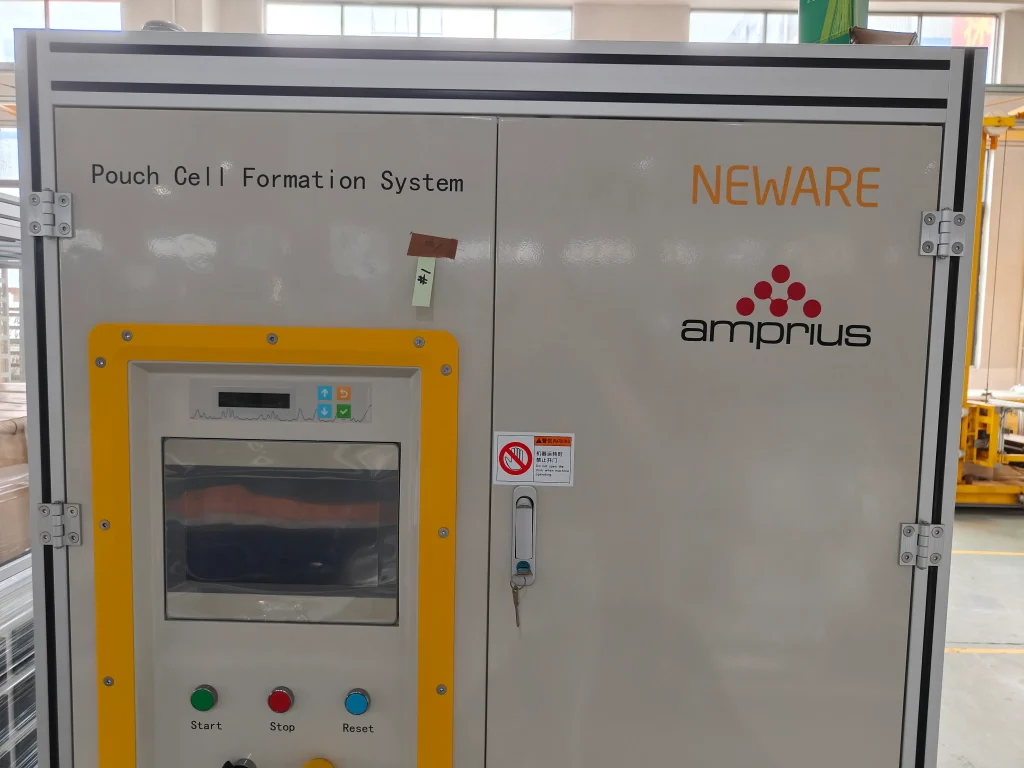
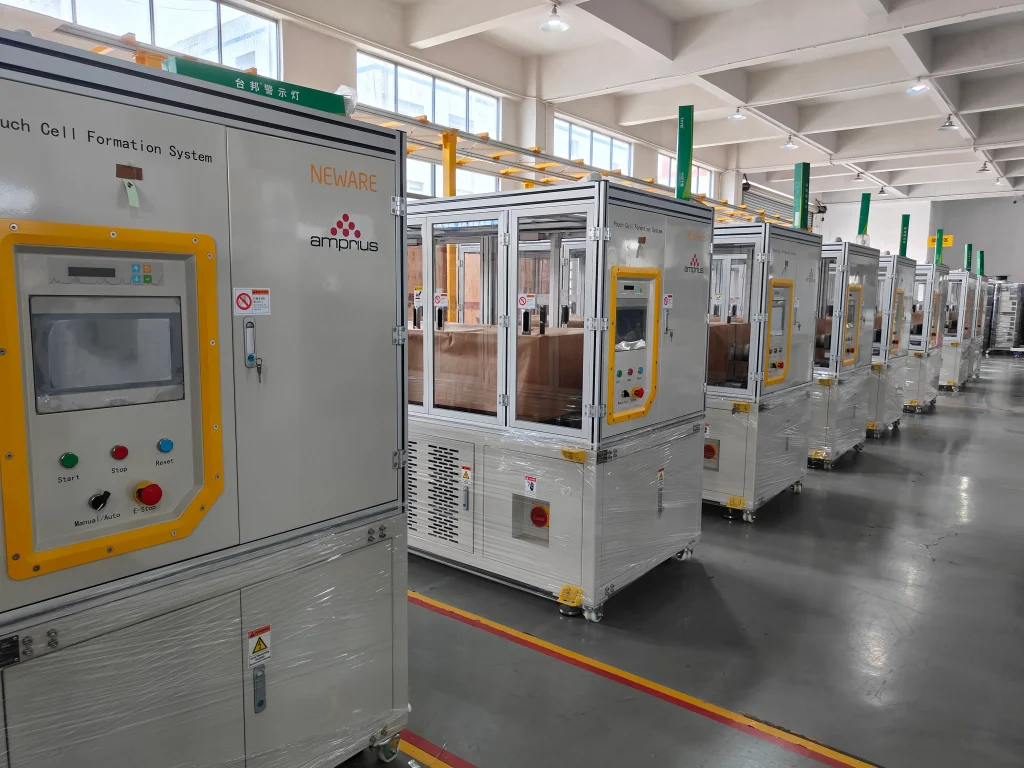
The pictures below show Neware’s customized pouch cell formation equipment for key accounts.
Battery Cell Formation: Process, Equipment Functions & Importance
1. What is Cell Formation?
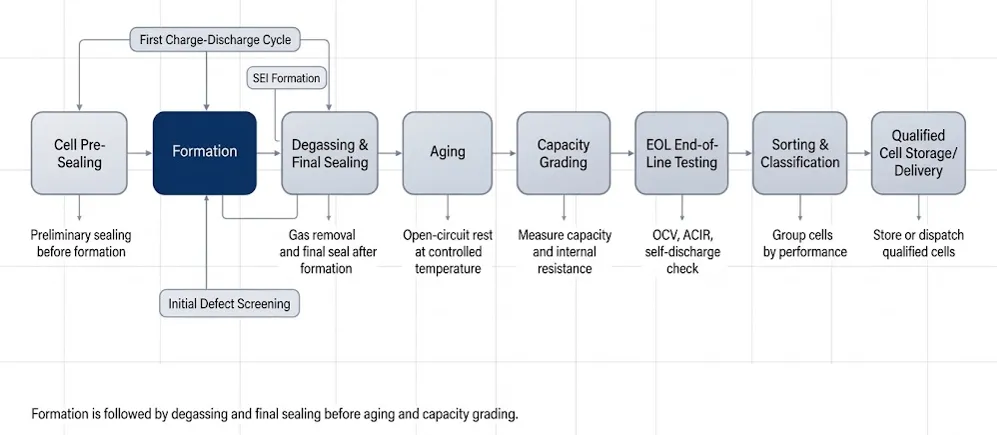
Cell formation is a critical electrochemical activation step after lithium-ion cell assembly, electrolyte filling and sealing. A freshly assembled cell is merely a stack of electrodes, separator and electrolyte without stable electrochemical performance. During formation, the cell undergoes controlled initial charge and discharge cycles under stable temperature. This activates active materials and forms a uniform, dense Solid Electrolyte Interphase (SEI) film on the anode surface. It removes residual impurities and internal stress inside the cell, turning a semi-finished cell into a stable, usable lithium-ion cell. Formation directly defines cell cycle life, safety, capacity consistency and charge-discharge efficiency.
Unlike normal charging, formation uses low-current, multi-step programmable charge-discharge profiles with strict temperature control. Low current avoids damaging internal cell structures, ensures complete, stable electrochemical reactions and fixes common issues of fresh cells: inconsistent initial performance, poor stability and short service life.
2. Core Functions of Cell Formation Equipment
Cell formation equipment is precision automation hardware dedicated to lithium-ion cell formation, supporting cylindrical, prismatic and pouch cells. It integrates high-precision power control, real-time data logging, thermal management, safety interlocks and energy regeneration. It is essential post-line equipment for lithium battery manufacturing.
2.1 Precision, Programmable Charge & Discharge Control
The system supports customizable multi-stage formation recipes: low-current pre-charge, constant-current charge, constant-voltage trickle charge and low-rate shallow discharge. Current and voltage are controlled with high accuracy (±0.1% FS). The process runs step-by-step per defined formation profiles. The initial low-current charging (0.05C–0.2C) enables slow, even SEI growth. It prevents SEI cracking or uneven thickness caused by excessive current and preserves stable anode interfaces over the cell’s life.
2.2 Stable Thermal Control
Formation systems come with integrated temperature chambers, maintaining process temperature between 25°C and 45°C with ±2°C accuracy. SEI formation and internal cell reactions are highly temperature-sensitive. A steady thermal environment minimizes unwanted by-products and interface defects, ensuring consistent formation results across mass-produced batches.
2.3 Real-time Data Acquisition & Quality Screening
The unit continuously records cell OCV, charge/discharge current, terminal voltage, capacity and temperature throughout the formation cycle. Automatic formation curves and batch quality reports are generated. Abnormal cells with voltage drift, excessive temperature rise or failed reactions are automatically detected and marked. This improves cell yield and batch quality control.
2.4 Multi-layer Safety Protection
Built-in safety modules provide real-time alarm and automatic shutdown for overcurrent, overvoltage, undervoltage, overtemperature, short circuit and leakage. It mitigates risks of cell swelling, thermal runaway and fire during formation, securing stable mass production.
2.5 Energy Regeneration & Energy Saving
Premium formation equipment adopts energy feedback technology. Power released during cell discharge is converted and fed back to the grid or reused for other charging channels. Compared with traditional resistive load systems, energy consumption drops by 30%–50%. It delivers low-carbon manufacturing while maintaining process precision.
2.6 Mass Automated Processing
Modular multi-channel design allows dozens to hundreds of cells to be processed in parallel. The equipment can interface with automated production lines for unmanned loading, formation, data logging and unloading. It boosts throughput for EV power batteries, energy storage batteries and consumer batteries.
3. Why Formation Matters
3.1 Build a high-quality SEI protective layer
The primary goal of formation is to grow a uniform, compact and stable nano-scale SEI film on the anode. This insulating film stops continuous side reactions between electrolyte and active materials, reduces electrolyte depletion and material corrosion. It lowers self-discharge and extends cycle and shelf life of lithium cells. A good SEI film is fundamental for long-term reliable cell operation.
3.2 Activate electrochemical performance
Formation fully activates lithium-ion intercalation / deintercalation of cathode and anode materials. It wakes up fresh cells and brings them up to rated capacity and standard charge-discharge performance, solving low initial capacity and inactive material problems.
3.3 Stabilize cell internal structure and performance
Controlled charge-discharge plus thermal conditioning removes residual gas, stress and unreacted impurities inside cells. It optimizes ion transport paths and stabilizes cell impedance. This reduces voltage drift, rapid capacity fade and performance fluctuation in early cell usage and improves batch-to-batch consistency.
3.4 Enhance cell safety and reliability
Formation exposes latent defects such as micro-shorts, electrode flaws and electrolyte filling abnormalities before downstream assembly. Defective units are screened out at this stage, preventing safety hazards in later assembly and end-use applications.
4. Applications
Cell formation equipment is widely used for cylindrical, prismatic and pouch lithium-ion cell mass production. Target markets include EV power batteries, stationary energy storage and consumer electronics batteries. It is standard equipment to improve battery consistency, extend service life and guarantee yield in lithium cell manufacturing.
Looking for reliable pouch cell formation systems for your lithium cell production?
Contact NEWARE today to discuss your project and get a quotation.