
When a lab starts looking for a battery tester, voltage and channel count usually come up first. Fair enough. But the part that quietly decides whether the data is clean or noisy is the current range — and how tightly the machine can hold it.
Anyone who has put coin cells on a high-current channel knows the problem. The numbers appear, yet the resolution is coarse, the low-rate points look rough, and comparing early-cycle coulombic efficiency between batches becomes harder than it should be. The same thing happens in reverse: a machine that only goes to 100 mA starts feeling limiting the moment the work moves to 18650s or small pouch prototypes.
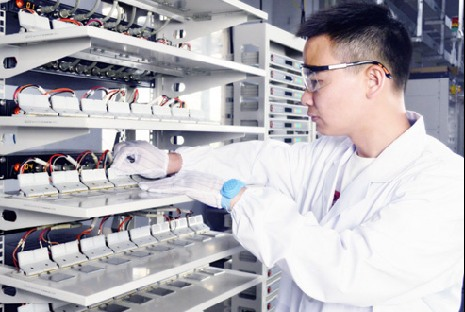
For material screening and coin-cell work, a multi-range unit that reaches into the microamp or low-milliamp region tends to be more useful than a single high-current channel. The Neware BTS-4008Q-5V100mA is one example: four auto-switching ranges (0.1 mA / 1 mA / 10 mA / 100 mA). The same channel can run a half-cell experiment at very low current and still handle a full cell later without swapping hardware. That flexibility shows up in the data quality, especially when you start looking at dQ/dV or trying to resolve small differences in early cycles.
A precision figure needs context. NEWARE lists current accuracy in percent of full scale for several BTS4000 configurations; the absolute uncertainty is different on a 100 mA range and a 6 A range. Record the selected channel range alongside each protocol, and compare measurement uncertainty with the changes you are trying to detect. For high-precision work, check the current model datasheet and calibration procedure rather than using one headline value across the series.
During method transfer between channels, check whether cable lengths, fixtures and ambient conditions are comparable. A small resistance or contact difference can become noticeable when working near the resolution limit. Keep one reference cell or test artefact and repeat the check periodically using the same recorded procedure.
Once the project moves to commercial-format cells, the current demand rises quickly. A 100 mA ceiling becomes a bottleneck. Units such as the BTS-4008Q-5V6A (up to 6 A) or the 12 A version give enough room for 1C–3C work on common cylindrical cells while still keeping a lower range available. Minimum discharge voltage is another detail that is easy to overlook. Some protocols and some chemistries need to go close to 0 V or slightly negative; not every tester supports that without an upgrade, so the specification sheet is worth checking rather than assuming.
Most labs end up balancing three practical constraints: the lowest current that still produces usable data, the highest C-rate required on the largest cell they plan to test, and how long channels will be locked in cycle-life experiments. Long-running tests reward stability and the ability to resume cleanly after a power cut more than they reward the highest peak current on the brochure. Temperature control often joins the conversation at this point. Pairing the cycler with a chamber — either a separate unit or one of the all-in-one systems that put the test channels inside the climate chamber — shortens cable runs and keeps every cell at the same temperature, which matters when the differences you are trying to measure are small.
The right cycler is simply the one whose ranges cover the cells and protocols you actually run. For early material work and coin cells, a high-precision multi-range unit in the 100 mA class is usually the more productive starting point. When larger cells arrive, higher-current channels can be added without throwing away the earlier investment. The current Neware BTS4000 series and the wider set of battery testing solutions are laid out so you can match the hardware to the next stage of the project rather than buying for a future that may never arrive.