Why is the Discharge Min Voltage of a Battery Tester So Critical? How to select from 1V, 0V and -5V discharge min voltage?
When selecting battery tester, most buyers focus heavily on maximum voltage and rated current. However, the discharge min voltage is often overlooked — yet it is a fundamental hardware constraint defined by the electrochemistry of different battery materials. Lithium iron phosphate, NMC ternary lithium, sodium-ion batteries and aqueous batteries each have distinct discharge cut-off requirements. Using a tester with an insufficiently low voltage limit will truncate discharge curves, produce incorrect capacity readings and even cause unintended over-discharge damage to cells.
| Battery Chemistry | Typical Minimum Discharge Cut-off Voltage |
|---|---|
| NMC/NCA Ternary Lithium | 2.75 – 3.0 V |
| LFP Lithium Iron Phosphate | 2.5 V |
| Sodium-ion Battery | 1.5 – 2.0 V |
| Aqueous Battery | ~1.0 V or lower |
1. What makes the minimum discharge voltage a hard constraint?
Every battery chemistry has a safe discharge floor. Discharging below this threshold triggers irreversible degradation.
- For ternary lithium cells: discharge below 2.75–3.0 V leads to severe graphite anode delithiation, copper current collector dissolution and permanent capacity loss.
- For LFP cells: discharge below 2.5 V enters the deep over-discharge zone, sharply shortening cycle life. LFP features an extremely flat discharge plateau, so voltage sampling accuracy near 2.5 V is critical. Poor low-voltage resolution may stop the test prematurely or allow dangerous over-discharge.
- For sodium-ion batteries: hard carbon anodes do not suffer copper foil dissolution like lithium systems. Cells can safely discharge down to 1.5 V. A tester limited to a 2.0 V cut-off will cut off the test early and underreport discharge capacity by 10–15%.
- For aqueous batteries: constrained by water’s 1.23 V electrochemical decomposition window, their full operating window sits at low voltage. Cells commonly finish discharge at 1.0 V or even 0.8 V. Low-voltage high-current operation imposes extra demands on tester stability, and fine voltage resolution is required to capture subtle plateau characteristics.
If your tester cannot reach the required cut-off voltage for your target battery chemistry, the test will not terminate correctly. The resulting data will misrepresent true cell performance.
2. Equipment selection checklist for low discharge voltage
Do not rely only on the printed “0 V to X V” hardware range. Verify these three key points:
- Current accuracy at low voltage Many testers advertise high voltage resolution only at mid-range voltage. Confirm whether constant current stability and current accuracy are maintained at your target low voltage, and request calibration data for low-voltage operating points.
- Software-configurable cut-off limit Some instruments can physically reach 0 V in hardware, but the software sets a minimum cut-off limit of 2.0 V. Hardware capability alone is meaningless if the software cannot be configured to match your required discharge cut-off.
- Future-proofing for new battery materials Your material roadmap matters. A tester qualified for ternary lithium may fail sodium-ion or aqueous battery testing later. A small investment in wider voltage range extends equipment service life and avoids costly full replacement as your R&D portfolio evolves.
3. Closing Summary
Battery chemistry defines the discharge voltage floor. The tester’s minimum discharge voltage defines whether you can fully measure the cell’s true discharge behaviour.
- Ternary lithium: standard 0–5 V testers are generally sufficient
- LFP: prioritise voltage sampling precision around 2.5 V
- Sodium-ion: minimum tester cut-off ≤ 1.5 V is mandatory
- Aqueous batteries: focus on constant current stability under low-voltage high-current conditions
Maximum voltage determines what high-potential systems you can test. Minimum discharge voltage determines whether you can test the cell all the way to its valid end-of-discharge point. Many test projects run into data discrepancy issues simply because teams ignored the low-voltage limit during equipment procurement.
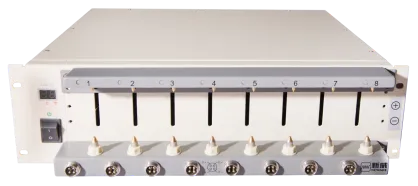
4. Take Neware battery testers as an example to show you how to select the right model.
For example:
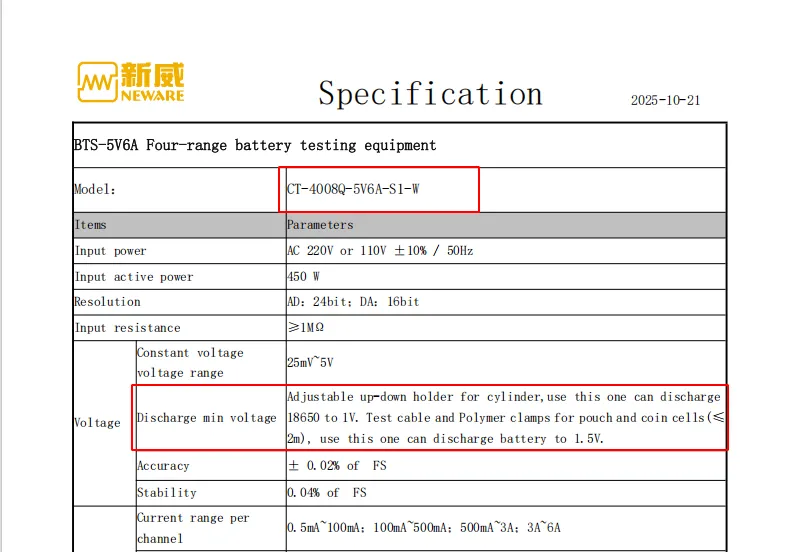
- The discharge min voltage of CT-4008Q-5V6A-S1-W is 1V and 1.5V.
(If you use the 18650/21700 up and down holder supplied with the equipment, this model can discharge your cell down to 1V. If you use test cables together with pouch cell clamps and the cable length is within 2 meters, this model supports discharging the battery down to 1.5V. The longer the cables you use, the higher the minimum discharge voltage will be.)
If your battery uses special materials, this equipment may not meet your test requirements.
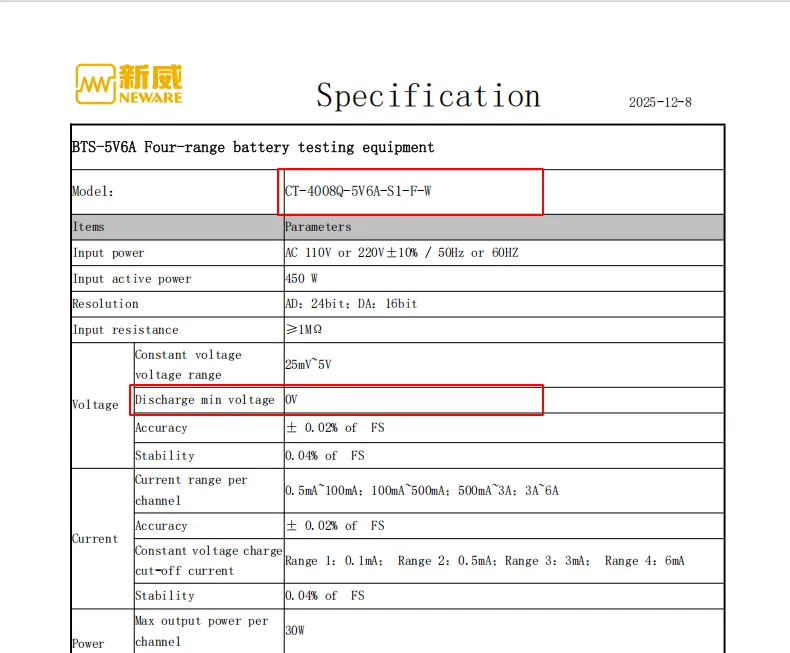
- The discharge min voltage of CT-4008Q-5V6A-S1-F-W is 0V.
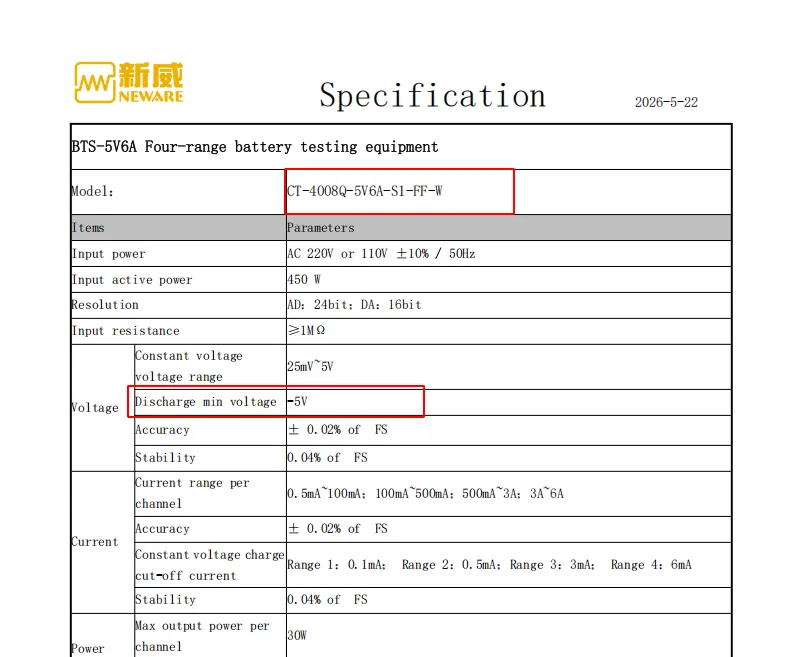
- The discharge min voltage of CT-4008Q-5V6A-S1-FF-W is -5V.