
A solid-state battery (SSB) is an advanced battery technology that replaces the liquid or gel-based electrolyte found in traditional lithium-ion batteries with a solid material.
While standard lithium-ion batteries use liquid organic solvents to transport lithium ions between the anode (negative electrode) and cathode (positive electrode), solid-state batteries use solid electrolytes made of ceramics, glass, sulfides, or solid polymers.
Fraunhofer ISI released its Solid‑State Battery Roadmap 2035+, gathering input from over 100 European experts to benchmark solid‑state battery (SSB) development against conventional liquid lithium‑ion batteries.
Key takeaways from this perspective paper:
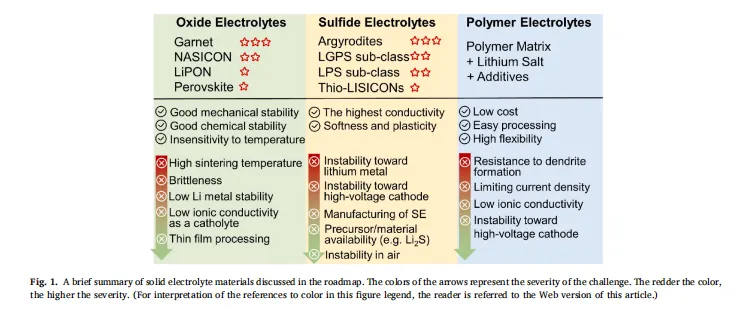
✅ Three major solid‑electrolyte families each have distinct trade‑offs
‑ Oxide (garnet): good chemical stability, yet high‑temperature sintering & brittleness limit manufacturing.
‑ Sulfide (argyrodite): top ionic conductivity and ductility, but sensitive to moisture & unstable vs high‑voltage cathodes.
‑ Polymer: low‑cost & easy to process, constrained by poor room‑temperature ionic conductivity.
No single electrolyte can meet all high‑energy‑density SSB requirements. Interfacial issues remain the biggest bottleneck.
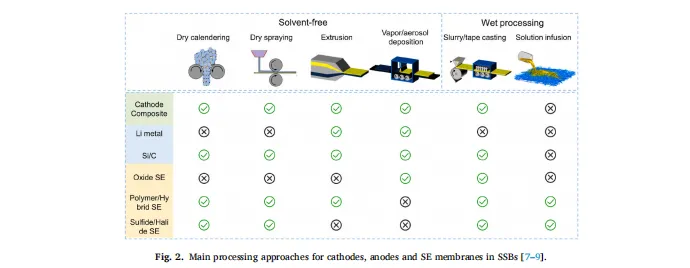
✅ Manufacturing: wet vs solvent‑free routes
Slurry casting is mature for large‑scale production, yet sulfide/oxide materials face solvent‑binder and sintering barriers. Dry calendering & dry spraying stand out as promising solvent‑free mass‑manufacturing candidates for all‑solid‑state cells.
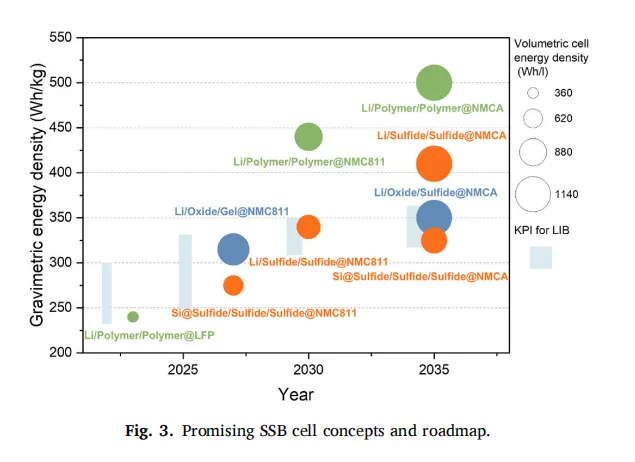
✅ Three technical routes & energy‑density outlook
1. Oxide‑based (quasi‑solid): Mid‑term target ~315 Wh/kg (2025‑2030); 350 Wh/kg by ~2035. Many Chinese players are advancing this quasi‑solid path.
2. Sulfide‑based: Highest theoretical potential. Li‑metal sulfide cell could hit 410 Wh/kg around 2035, though Li‑dendrite risks persist.
3. Polymer‑based: Already commercialized but requires elevated operating temperature.
✅ Market forecast
Liquid LIB will keep dominating for a long period. SSBs will serve as complementary solutions. Quasi‑solid‑state batteries are now on the verge of mass production.
Multiple SSB technical paths need parallel R&D; there is still no clear winning route for automotive high‑volume applications.