
Executive Summary
The low-altitude economy and electric vertical takeoff and landing (eVTOL) aircraft are rapidly transitioning from conceptual prototypes to commercial flight certification and fleet deployment. While high gravimetric energy density (Wh/kg) dominates industry headlines, real-world flight operations demand an uncompromising balance between dynamic high-rate power output, ultra-fast charging, thermal containment, and cell-to-cell consistency. For aviation battery developers, cell manufacturers, and eVTOL OEMs, rigorous high-power battery testing and consistency validation are the bedrock of operational safety and commercial viability.

Part 1: Industry Trends – The Rise of Low-Altitude Aviation and the Demands on Flight-Grade Batteries
Recent industry reports and policy updates highlight accelerated momentum in the low-altitude economy. Driven by urban air mobility (UAM) trials, emergency medical services, and regional logistics, global investment in eVTOL architectures continues to scale rapidly. Commercial flight operations are targeting broad deployment within the 2026–2030 timeframe as regulatory bodies (such as CAAC, FAA, and EASA) finalize type certification frameworks.
From a battery engineering perspective, transitioning from road-bound Electric Vehicles (EVs) to low-altitude electric aviation introduces a paradigm shift in battery performance requirements:
1. Extreme Power Profiles (High C-Rate Burst Demand):
Unlike EVs that cruise at modest discharge rates, eVTOL aircraft demand extreme discharge rates (often **5C to 10C or higher**) during vertical takeoff, hovering, and landing phases, followed by lower-rate continuous discharge during wing-borne cruise flight.
2. Strict Energy Density Boundaries (300+ Wh/kg):
Every extra gram of battery pack weight directly reduces payload capacity or flight range. Manufacturers are adopting advanced high-nickel ternary, semi-solid-state, and solid-state chemistries to break the 300–400 Wh/kg barrier.
3. Rapid Turnaround & Fast-Charging Pressure:
Fleet economics require minimal ground turnaround time. Batteries must support 3C to 5C ultra-fast DC charging without inducing lithium plating, accelerated degradation, or localized thermal hotspots.
4. Zero-Tolerance Safety & Flight-Grade Consistency:
Battery failure in mid-air is not an option. Cell-to-cell inconsistency in capacity, DCIR (Internal Resistance), and thermal dissipation can trigger premature voltage sag or thermal runaway.
Consequently, for eVTOL battery manufacturers, the core challenge is transforming high-density electrochemistry into predictable, zero-defect flight performance through rigorous, high-dynamic testing.
Part 2: Technical Specifications & Testing Parameters for eVTOL Aviation Batteries
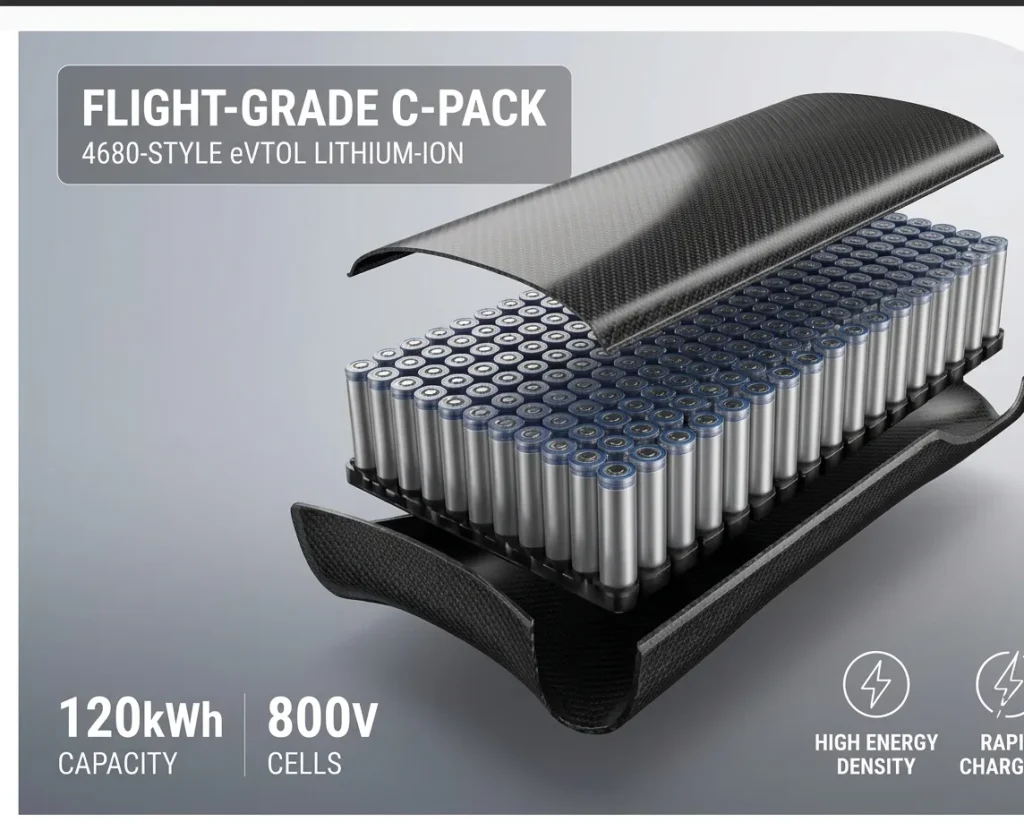
Commercial eVTOL architectures currently operate primarily on 400V to 800V high-voltage platforms (with operating peak voltages reaching ~576V–835V+ to minimize cable weight and transmission loss), while next-generation platforms are progressing toward 1000V+ architectures. Below is a realistic technical matrix outlining key battery parameters, test current profiles, and validation focus areas across primary eVTOL applications:
| eVTOL Aircraft Architecture | Battery Chemistry / Form Factor | Typical Pack Operating Voltage (V) | Typical Battery Pack Capacity | Peak Takeoff & Hover Discharge Rate (C-rate) | Cruise Discharge Rate | Fast Charge Acceptance (C-rate) | Key Testing & Validation Focus |
| Urban Air Taxi (Lift + Cruise / Tilt-Rotor) | Semi-Solid State / High-Nickel Pouch or 4680 Cylindrical | 400V – 800V Platform (Peak: ~576V – 835V) | 100 kWh – 300 kWh | 5C – 10C (Continuous pulse during takeoff/hover) | 1C – 2C continuous | 3C – 5C (SOC 20% to 80% in <15 mins) | Millisecond-level dynamic impulse load testing; high-voltage insulation (Hi-pot); DCIR growth over 1,000+ fast-charge cycles; thermal propagation containment. |
| Short-Hop Multicopter (Passenger / Cargo Logistics) | Ultra-High Power Lithium Pouch Cell | 400V – 800V Platform | 50 kWh – 150 kWh | 8C – 12C short bursts | 2C – 3C continuous | 4C – 6C | Extreme current step-change response time; voltage sag & recovery under peak hover loads; thermal runaway prevention; environmental chamber stress testing (-20°C to +60°C). |
| Next-Gen / Long-Range Air Mobility (Hybrid / E-CTOL) | Advanced High-Density Solid-State / Pouch | 800V – 1000V+ Platform (Future-Proof) | 200 kWh – 500+ kWh | 3C – 6C | 0.8C – 1.5C long duration | 2C – 4C | Multi-channel cell consistency sorting (OCV/IR/Capacity); long-term cyclic aging under simulated flight mission profiles; SOC/SOH estimation algorithm validation. |
| BMS & Aviation Battery Module Verification | Module / Sub-system Pack | 14.8V – 75.6V (Module) / 400V–800V (Bus) | 10 kWh – 50 kWh (Module) | Matches flight mission power profile | Matches cruise profile | Dynamic fast-charge simulation | Real-time hardware-in-the-loop (HIL) BMS testing; CAN/EtherCAT bus communication latency under high current noise; cell-balancing efficiency validation. |
Part 3: Advanced Battery Testing Systems Engineered for eVTOL & Low-Altitude Aviation
Testing aviation-grade batteries requires specialized, high-power, high-accuracy testing equipment capable of replicating real-world flight missions without power lag or measurement drift. Standard automotive battery testers often fail to deliver the dynamic response times and ultra-high sampling rates demanded by aviation safety standards.
Recommended Solution: High-Dynamic High-Voltage Battery Testing System
Designed specifically for next-generation aviation cells, modules, and high-voltage packs, our Aviation-Grade High-Power Battery Testing Systems deliver the accuracy, speed, and safety needed for type certification and mass manufacturing quality control.
Key System Advantages:
1. Wide Voltage Coverage with Future-Proof Reserve (Up to 1000V/1200V):
Fully supports current 400V–800V commercial eVTOL packs while offering high-voltage testing headroom up to **1000V / 1200V** for next-generation aviation R&D, ensuring long-term equipment value.
2. Ultra-Fast Dynamic Response (<1 ms Step Time):
Features sub-millisecond current response time (<1 ms) to seamlessly simulate real-world flight power profiles—such as sudden gusts, rapid vertical takeoff bursts, and regenerative braking during landing.
3. High-Precision Energy Regeneration (>93% Efficiency):
Utilizes advanced Silicon Carbide (SiC) power electronics to feed discharge energy back into the local power grid with >93% efficiency, dramatically reducing operational electricity costs during intensive multi-cycle flight profiling.
4. Synchronized Multi-Physics & Thermal Chamber Integration:
Seamlessly integrates with environmental test chambers, multi-channel thermal sensors, and electrochemical impedance spectroscopy (EIS) modules to evaluate DCIR and internal heating gradients under altitude and temperature extremes.
5. Flight Mission Simulation & Aviation Compliance Software:
Pre-loaded with standardized testing workflows for FAA/EASA/CAAC aviation qualification, enabling automated script generation for multi-stage mission simulation, SOC/SOH algorithm validation, and MES/PLM data traceability.
Empower Your Aviation Battery Certification Today
Whether you are developing next-generation semi-solid cells for 300 Wh/kg energy thresholds, validating high-voltage BMS safety algorithms, or scaling up production lines for 800V eVTOL battery packs, our high-precision test equipment provides the validation rigor your program demands.
📩 Contact the Neware team now to get the battery tester’s specifications or arrange a demonstration!