Neware BTS 8.0:Why do two separate cycle datasets occasionally get merged? How should we handle this issue?
According to customer feedback, the data works fine during cycle testing. This issue (two independent datasets getting merged) only occurs when running the C‑rate test.
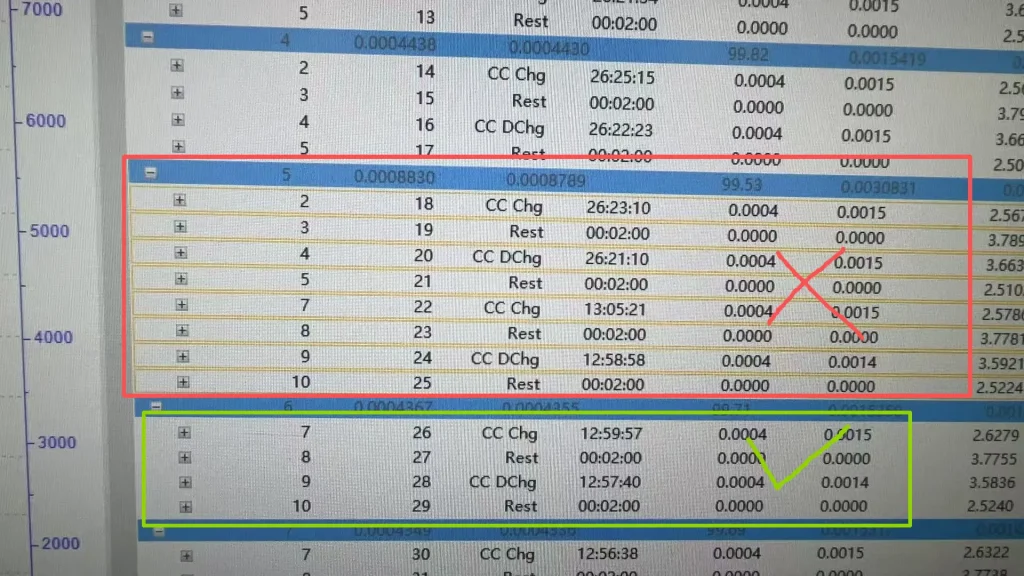
Right‑click within the test‑data area, then select Cycle statistics / calculation.
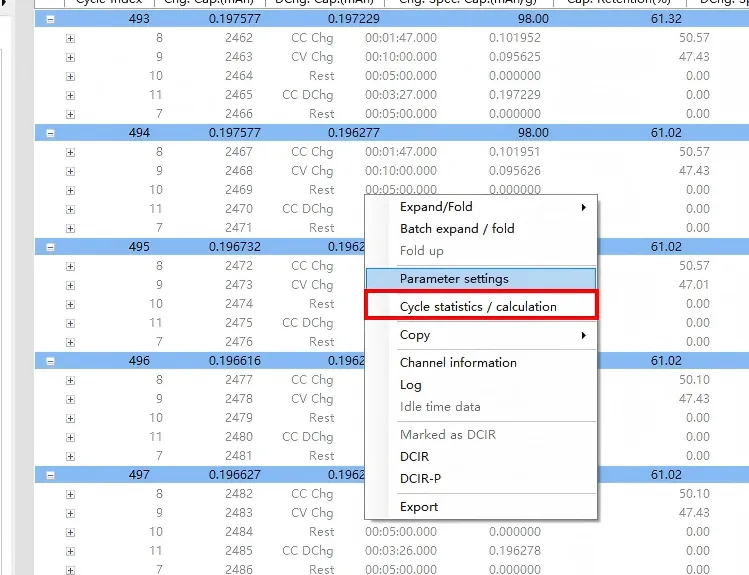
Right‑click within the test‑data area, then select Cycle statistics / calculation. This setting defines how the software identifies and counts each cycle, which can resolve the issue where two independent cycle datasets get merged.
Select either **Charge First** or **Discharge First** according to your test steps.

Based on the first figure, you should select Charge First for this case.
The following content is from AI and is for reference only:
Half-Cell Testing Protocol Guide: Mastering First-Cycle Sequences
When running half-cell electrochemical tests, aligning the step sequences (Charge vs. Discharge) with the underlying reaction is essential for accurate data. Here is a quick reference guide:
- Conventional Anode Half-Cell (Graphite / Si-C as WE, Li foil as CE)First Cycle Sequence: Start with Discharge (Lithiation), then Charge (Delithiation).Mechanism: WE potential decreases as Li ions embed into the anode (reduction).
- Pre-lithiated Anode / Pre-lithiated SamplesFirst Cycle Sequence: Start with Charge (Delithiation), then Discharge (Lithiation).Mechanism: The electrode already contains active Li, so initial potential increases as Li ions extract (oxidation).
- Lithium Metal as Working Electrode (Symmetric / Asymmetric cells)First Cycle Sequence: Start with Discharge (Li deposition / Plating), then Charge (Li stripping).Mechanism: Reduction (Li+ + e- -> Li0) corresponds to Discharge (Plating); Oxidation (Li0 -> Li+ + e-) corresponds to Charge (Stripping).
- Cathode Half-Cell (Cathode as WE, Li foil as CE)First Cycle Sequence: Start with Charge (Delithiation), then Discharge (Lithiation).Mechanism: Pristine cathode materials are in a fully lithiated state, requiring initial extraction of Li ions (oxidation).
- Disassembled Aged Anode (Harvested from fully charged full cells)First Cycle Sequence: Start with Charge (Delithiation).Mechanism: The harvested anode is in a lithiated state, so the test must begin by de-lithiating the electrode.
Important Note for Battery Testing Systems (e.g., NEWARE BTS):
- Software Definition: Tester software labels “Charge” and “Discharge” strictly based on current direction and potential change, not electrochemical terms.Charge = Positive current / Potential increasesDischarge = Negative current / Potential decreases
- Polarity Check: Always double-check channel wiring and cell polarity before running the schedule. Reversed polarity will invert current direction, leading to test failure or cell damage.
#BatteryTesting #Electrochemistry #LithiumIonBatteries #EnergyStorage #ResearchAndDevelopment #BatteryResearch #LithiumMetal
I hope this post is helpful to you. ☺️