
The Hidden Risks of Coin‑Cell Testing: Building Reliable Hand‑Assembled Lithium‑Ion Full Coin Cells
Lithium‑metal half‑coin cells are everywhere in battery labs for early‑stage cathode screening. They are quick to put together and often produce consistent‑looking data. But this common testing method has real blind spots that can send material development down the wrong path.
In half‑cell setups, the lithium‑metal counter electrode acts as an almost unlimited lithium source. That excess lithium covers up irreversible side reactions and lithium inventory loss — failure modes that will absolutely show up in real lithium‑ion full cells. It is a familiar pain point for many researchers: you get great cycling numbers in half‑cells, yet that same cathode falls flat once built into a proper full‑cell stack.
Commercial pouch cells deliver excellent test repeatability, but running custom pouch‑cell batches costs significant time and resources. For teams screening lots of new electrode materials, full pouch‑cell runs are often not practical. What researchers needed was a low‑cost, reliable way to build usable full coin cells in‑house.
This is exactly what Murray, Hall and Dahn laid out in their 2019 *Journal of The Electrochemical Society* work from Dalhousie University. Their paper walks through how to build reproducible NMC622 / graphite full coin cells for academic material evaluation.
One eye‑opening finding came from their initial test builds. When they assembled full coin cells using the standard tweezer‑handling workflow borrowed from half‑cell practice, small electrode misalignment kept popping up. Springs and spacers, placed at a slight angle with tweezers, would shift the stack. Where graphite anode did not fully cover the cathode surface, lithium plated on those exposed areas.
Even using identical materials, hardware and test parameters, cell performance varied wildly. After 100 cycles, capacity retention across nominally‑identical cells ranged from 80 % up to 95 %. All this spread traced back purely to mechanical misalignment introduced during manual assembly.
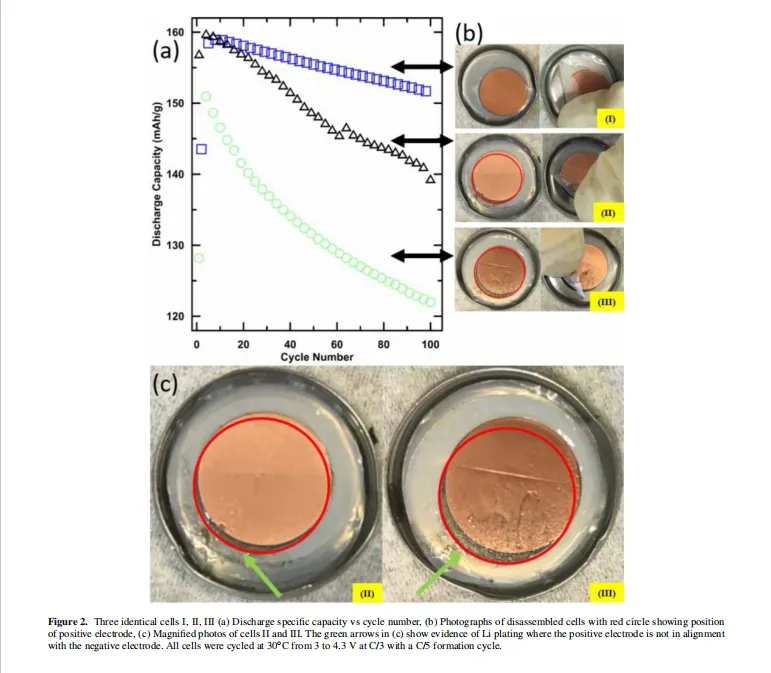
of positive electrode, (c) Magnified photos of cells II and III. The green arrows in (c) show evidence of Li plating where the positive electrode is not in alignment
with the negative electrode. All cells were cycled at 30◦C from 3 to 4.3 V at C/3 with a C/5 formation cycle.
The team landed on two simple, high‑impact fixes to bring consistency back:
- Use a vacuum pen to set springs and spacers straight down from above. This avoids the sideways shift that happens when manipulating parts with tweezers.
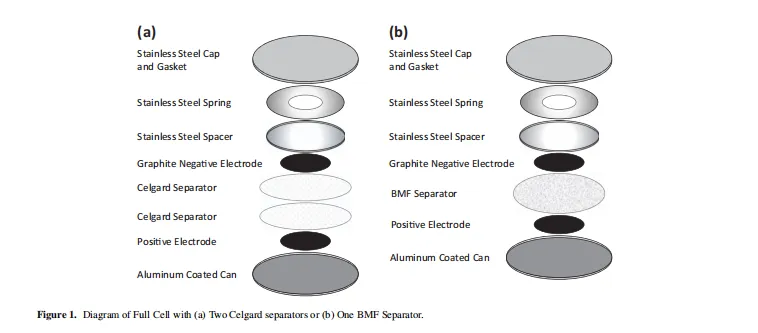
- Swap the commonly‑used dual‑layer Celgard separator stack for one thicker, compressible BMF separator. This helps keep pressure evenly distributed across electrodes during crimping.
Pair those two changes with cathode and anode disks cut to equal diameters, and their hand‑built full coin cells reached performance repeatability close to off‑the‑shelf commercial pouch cells.
The paper also drives home a lab reality many learn the hard way: even small temperature fluctuations will skew cycling results. You cannot skip tight temperature control, no matter how well you assemble your cells.
This protocol fills a very practical gap in the testing workflow:
Half‑cells (fast but can mislead) → lab‑built full coin cells → commercial pouch cells (high quality, resource heavy)
It gives researchers a middle ground to avoid over‑optimistic conclusions built only on lithium‑metal half‑cell outputs. Assembly artifacts are not minor noise. Small cell‑building choices can completely change how you judge an electrode material.
If you do battery research or battery materials research, you might be interested in these products:
Coin cell cycler and pouch cell cycler
Neware all in one for coin cells and pouch cells