
In lithium-ion battery research, every lab faces the same frustrating question: Why does a promising new cathode material perform flawlessly in a coin cell, only to rapidly degrade once assembled into a practical full coin cell?
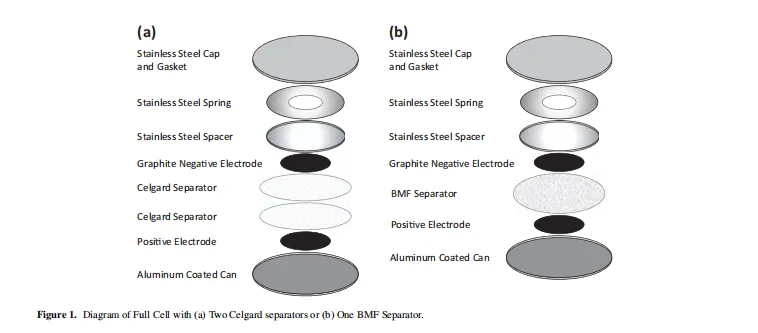
Commercial machine-made pouch cells deliver rock-solid, reproducible data (with discharge capacity relative standard deviations around 0.5%), yet custom pilot runs are far too expensive for high-throughput material screening. On the other hand, standard lithium metal half-cells are cheap and convenient, but their massive excess of lithium masks capacity loss from electrolyte side reactions—creating a dangerous “half-cell illusion” that can send R&D teams down dead ends. Until now, bridging this gap with hand-made graphite full coin cells has felt more like guesswork than science.
To eliminate this experimental bottleneck, world-renowned battery pioneer Professor J. R. Dahn’s group at Dalhousie University published a definitive methodology paper in the Journal of The Electrochemical Society (“A Guide to Full Coin Cell Making for Academic Researchers”). By dissecting failed cells in an argon glovebox, the team uncovered the exact physical culprits behind erratic full coin cell data—and demonstrated how two straightforward hardware upgrades can push hand-made coin cell precision to rival commercial pouch cells.
I. Why Do Conventional Full Coin Cells Suffer from Poor Reliability?
In standard half-cell setups, the lithium metal counter/reference electrode is intentionally oversized relative to the working electrode, providing a wide margin of error for alignment. However, optimizing practical full cells requires pairing positive and negative electrode disks of identical diameters to manage the N/P ratio and suppress edge-plating issues.
When the Dahn team initially constructed replicate NMC622/graphite full coin cells using conventional half-cell procedures (tweezers for assembly and double Celgard separators), the results were alarmingly inconsistent: after 100 cycles, three nominally identical cells retained ~95%, ~90%, and ~80% of their initial capacity, respectively.
Post-test disassembly in an argon glovebox revealed two primary culprits behind this performance divergence:
- Micron-Scale Electrode Misalignment and Lithium Plating: Post-mortem analysis showed that poorly performing cells suffered from subtle physical offsets between the cathode and anode. During charging, regions of the positive electrode left uncovered by the negative electrode experienced severe metallic lithium plating, permanently consuming active lithium inventory and accelerating capacity decay.
- Crimp-Induced Internal Pressure Heterogeneity: The crimping process causes coin cell casings to bow slightly outward. While a soft, ductile lithium foil in a half-cell easily deforms to maintain uniform contact pressure, rigid graphite anodes coated on copper current collectors do not. Combined with thin, stiff separators, this results in uneven pressure distribution and localized contact loss across the electrode surface.
II. Core Breakthroughs: Two Structural and Procedural Upgrades
To address these failure modes, the Dahn group introduced two deceptively simple yet transformative engineering modifications:
1. Replacing Tweezers with a Vacuum Pen
The team discovered that electrode misalignment rarely occurs when placing the initial electrodes; rather, it happens during the final step when the stainless steel spacer and spring are dropped into the cell stack. Using conventional tweezers forces the operator to grip these components from one side, releasing them at a slight angle. Even this minor drop generates a lateral shear force strong enough to nudge the underlying separator and anode out of alignment.
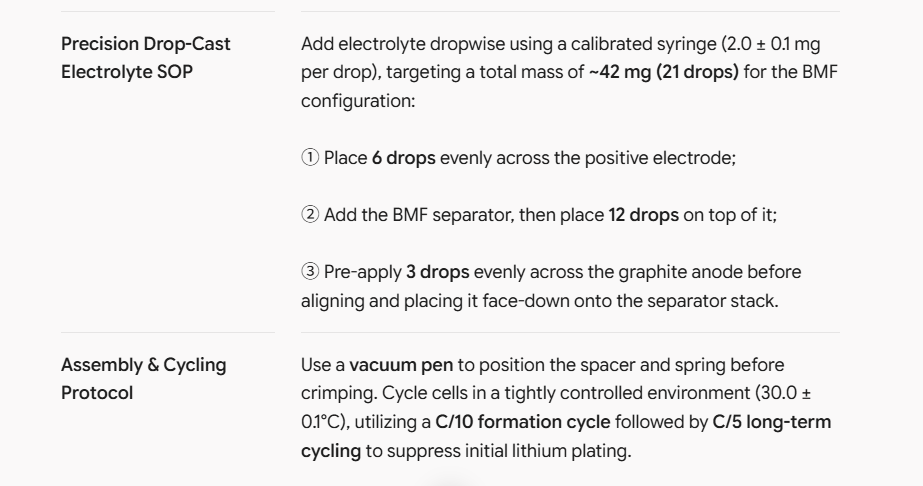
The Solution: Adopting a vacuum pen (e.g., Virtual Industries V8901) to pick up and vertically lower the spacer and spring from directly overhead, eliminating lateral friction and ensuring uniform placement.
2. Substituting Dual Celgard Separators with a Single BMF Separator
To mitigate internal stress variations caused by casing deformation, the team replaced the conventional double-layer Celgard separators with a single layer of polypropylene Blown Micro Fiber (BMF) separator (sourced from 3M Company).
- Physical Advantages: BMF separators are roughly 0.25mm thick, feature a high porosity of about 90%, and are exceptionally soft and compressible, acting as an internal cushion that absorbs mechanical tolerances and maintains uniform stack pressure across the entire electrode area.
- Material Warning: Although glass fiber separators are similarly thick and compliant, the authors avoided them due to the high risk of chemical leaching and adverse reactions with LiPF6 electrolytes.
III. Standardized Experimental Parameters and Electrolyte SOP
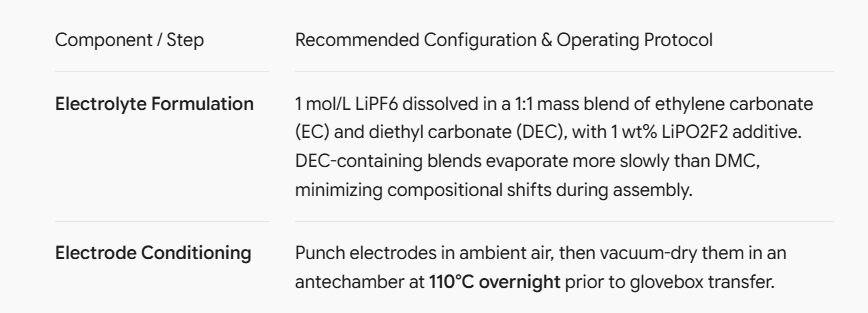
To help researchers seamlessly reproduce these results, the validated configuration and quantitative electrolyte protocol (based on 2032-format hardware, cathode mass loading of 21.3 mg/cm2, anode mass loading of 13.2 mg/cm2, and matching 1.27 cm electrode diameters) are outlined below:
IV. Validation: Matching Industrial Pouch Cell Precision
In their final comparative validation, the Dahn group benchmarked their optimized NMC622/graphite full coin cells against industrial 240 mAh machine-made pouch cells fabricated with identical electrode formulations and electrolyte batches.
The findings demonstrate that when assembled using matching diameters, a single BMF separator, and a vacuum pen, hand-made full coin cells achieve dramatically superior precision that closely approaches commercial pouch cell quality (exhibiting tightly overlapping capacity retention curves across 100 to 200 cycles). Furthermore, seasonal data comparisons emphasized that precise thermal management (30.0 ± 0.1°C) is just as vital as mechanical assembly precision when evaluating subtle degradation mechanisms.
This work provides the academic community with a cost-effective, highly reliable framework for evaluating advanced lithium-ion chemistries. By investing in a vacuum pen, switching to a compressible BMF separator, and adhering to strict drop-cast and slow-formation protocols, researchers can successfully leverage full coin cells to accurately predict real-world material performance without the prohibitive overhead of custom pouch cell production.
Reference:
Murray, V., Hall, D. S., & Dahn, J. R. (2019). A Guide to Full Coin Cell Making for Academic Researchers. Journal of The Electrochemical Society, 166(2), A329–A333. DOI: 10.1149/2.1171902jes
As we know, the performance of coin cells is highly temperature-dependent, so many battery researchers and scientists are now adopting the Neware All-in-One system.
This unit supports 160 coin cells. It integrates 160 channels of 5V 100mA battery cyclers inside a 0~60°C chamber, which helps save your lab space.
Feel free to let me know if you’d like more information. Neware